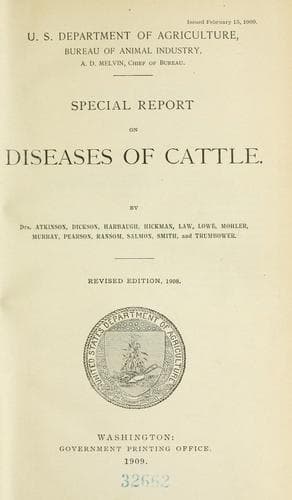
Special report on diseases of cattleUnited States. Bureau of Animal Industry
Science
Special report on diseases of cattle
United States. Bureau of Animal Industry
Cattle -- Diseases
_Treatment._--Treatment consists in first clearing away the irritant
present in the bowels. For this purpose 1 or 2 ounces of castor oil with 20
drops of laudanum may be given, and if the sour eructations are marked a
tablespoonful of limewater or one-fourth ounce calcined magnesia may be
given and repeated two or three times a day. If the disorder continues
after the removal of the irritant, a large tablespoonful of rennet, or 30
grains of pepsin, may be given at each meal along with a teaspoonful of
tincture of gentian. Any return of constipation must be treated by
injections of warm water and soap, while the persistence of diarrhea must
be met as advised under the discussion following this. In case of the
formation of loose hair balls inclosing milk undergoing putrid
fermentation, temporary benefit may be obtained by giving a tablespoonful
of vegetable charcoal three or four times a day, but the only real remedy
is to cut the paunch open and extract them. At this early age they may be
found in the third or even the fourth stomach; in the adult they are
confined to the first two and are comparatively harmless.
DIARRHEA (SCOURING) IN CALVES (SIMPLE AND CONTAGIOUS).
As stated in the last article, scouring is a common result of indigestion,
and at first may be nothing more than an attempt of nature to relieve the
stomach and bowels of offensive and irritating contents. As the indigestion
persists, however, the fermentations going on in the undigested masses
become steadily more complex and active, and what was at first the mere
result of irritation or suspended digestion comes to be a genuine
contagious disease, in which the organized ferments (bacteria) propagate
the affection from animal to animal and from herd to herd. More than once I
have seen such epizootic diarrhea start on the headwaters of a creek and,
traveling along that stream, follow the watershed and attack the herds
supplied with water from the contaminated channel. In the same way the
disease, once started in a cow stable, is liable to persist for years, or
until the building has been thoroughly cleansed and disinfected. It may be
carried into a healthy stable by the introduction of a cow brought from an
infected stable when she is closely approaching calving. Another method of
its introduction is by the purchase of a calf from a herd where the
infection exists.
Public-domain text, read in full here on John Shaqi.
Reviews
Reviews
No reviews yet
Be the first to share your thoughts on this work.
Elsewhere in the archive
Join the Discussion
Join the discussion
Sign in to leave a comment or review.
Sign InorCreate an account