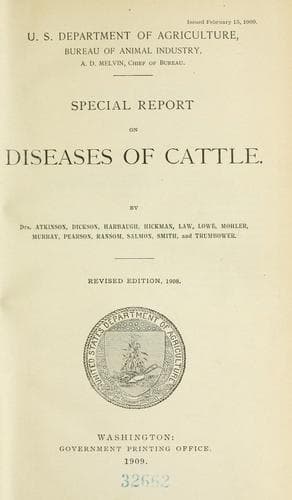
Special report on diseases of cattleUnited States. Bureau of Animal Industry
Science
Special report on diseases of cattle
United States. Bureau of Animal Industry
Cattle -- Diseases
In enumerating the other causes of this disease we may refer to those noted
above as inducing indigestion. As a primary consideration any condition
which lowers the vitality or vigor of the calf must be accorded a prominent
place among factors which, apart from contagion, contribute to start the
disease de novo. Other things being equal, the strong, vigorous races are
the least predisposed to the malady, and in this respect the compact form,
the healthy coat, the clear eye, and the bold, active carriage are
desirable. Even the color of the hair is not unimportant, as in the same
herd I have found a far greater number of victims among the light colors
(light yellow, light brown) than among those of a darker tint. This
constitutional predisposition to indigestion and diarrhea is sometimes
fostered by too close breeding, without taking due account of the
maintenance of a robust constitution; hence animals that are very much
inbred need to be especially observed and cared for unless their inherent
vigor has been thoroughly attested.
The surroundings of the calf are powerful influences. Calves kept indoors
suffer to a greater extent than those running in the open air and having
the invigorating influences of sunshine, pure air, and exercise; close,
crowded, filthy, bad-smelling buildings are especially causative of the
complaint. The presence in the air of carbon dioxid, the product of
breathing, and of the fetid, gaseous products of decomposing dung and urine
diminish by about one-fourth of their volume the life-giving oxygen and in
the same ratio hinder the aeration of the blood and the maintenance of
vigorous health. Worse than this, such fetid gases are usually direct
poisons to the animal breathing them; for example, sulphureted hydrogen
(hydrogen sulphid 2 SH_{2}) and various alkaloids (ptomaines) and toxins
(neutral poisonous principles) produced in the filth fermentations. These
lower the general health and stamina, impair digestion, and by leading to
the accumulation in stomach and bowels of undigested materials they lay the
foundation for offensive fermentations within these organs and consequent
irritation, poisoning, and diarrhea. They further weaken the system so that
it can no longer resist and overcome the trouble.
The condition of the nursing cow and her milk is another potent cause of
trouble. The feed of the cow is important. The influence of this is shown
in the following tables:
_Influence of feed on milk._ (_From Becquerel and Vernois._)
Public-domain text, read in full here on John Shaqi.
Reviews
Reviews
No reviews yet
Be the first to share your thoughts on this work.
Elsewhere in the archive
Join the Discussion
Join the discussion
Sign in to leave a comment or review.
Sign InorCreate an account