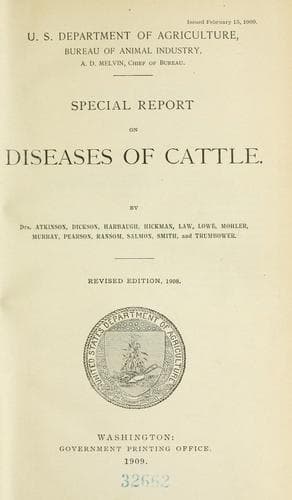
Special report on diseases of cattleUnited States. Bureau of Animal Industry
Science
Special report on diseases of cattle
United States. Bureau of Animal Industry
Cattle -- Diseases
Cows fed on overkept, fermented, and soured rations have acid milk, which
readily turns and coagulates. Thus old, long-kept brewer's grains, swill,
the refuse of glucose factories, and ensilage which has been put up too
green all act in this way. The same may come from disease in the cow's
udder, or any general disease of the cow with attendant fever, and in all
such cases the tendency is to rapid change and unwholesomeness. If the milk
is drawn and fed from a pail, there is the added danger of all sorts of
poisonous ferments getting into it and multiplying; it may be from the
imperfect cleansing and scalding of the pail; from rinsing the pails with
water that is impure; from the entrance of bacterial ferments floating in
the filthy atmosphere of the stable, or from the entrance of the volatile
chemical products of fermentation.
In addition to the dangers coming through the milk, the calf suffers in its
digestive powers from any temporary illness, and among others from the
excitement attendant on the cutting of teeth, and impaired digestion means
fermentations in the undigested masses and the excessive production of
poisonous ptomaines and toxins.
Whatever may be the starting or predisposing cause of this malady, when
once established it is liable to perpetuate itself by contagion and to
prove a veritable plague in a herd or a district.
_Symptoms._--The symptoms of a diarrhea may appear so promptly after birth
as to lead to the idea that the cause already existed in the body of the
calf, and it usually shows itself before the end of the second week. It may
be preceded by constipation, as in retained meconium, or by fetid
eructations and colicky pains, as in acute indigestion. The tail is stained
by the liquid dejections, which are at first simply soft and mixed with
mucus with a sour odor, accompanied with a peculiar and characteristic
fetor (suggesting rotten cheese), which continually grows worse. The
quantity of water and mucus steadily increases, the normal predominance of
fatty matters becoming modified by the presence of considerable undigested
casein, which is not present in the normal feces, and in acute cases death
may result in one or two days from the combined drain on the system and the
poisoning by the absorbed products of the decomposition in the stomach and
bowels. When the case is prolonged the passages, at first 5 or 6 a day,
increase to 15 or 20, and pass with more and more straining, so that they
are projected from the animal in a liquid stream. The color of the feces,
at first yellow, becomes a lighter grayish yellow or a dirty white (hence
the name white scour), and the fetor becomes intolerable.
Public-domain text, read in full here on John Shaqi.
Reviews
Reviews
No reviews yet
Be the first to share your thoughts on this work.
Elsewhere in the archive
Join the Discussion
Join the discussion
Sign in to leave a comment or review.
Sign InorCreate an account