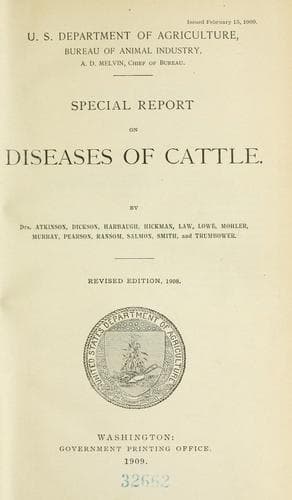
Special report on diseases of cattleUnited States. Bureau of Animal Industry
Science
Special report on diseases of cattle
United States. Bureau of Animal Industry
Cattle -- Diseases
In small, old, ventral hernias the method of compressing and sloughing off
the skin has been used successfully. If the hernia is large a radical
operation will be necessary, and this is also true when the symptoms
indicate that a hernia is strangulated. This operation is performed by
cutting down on the hernia, restoring the organ to the abdominal cavity,
and then closing the wound with two sets of stitches; the inner stitches,
in the muscular wall, should be made with catgut and the outer stitches, in
the skin, may be made with silk or silver wire. The strictest surgical
cleanliness must be observed. Bleeding vessels should be tied. Then a
compress composed of ten or twelve folds of cloth must be placed smoothly
over the seat of injury and a bandage applied around the body, the two ends
being fastened at the back. In the smaller kinds of hernia, nitric acid may
sometimes be applied with success. This treatment should not be applied
until the swelling and inflammation attending the appearance of the hernia
have subsided; then, the contents of the hernia having been returned, the
surface of skin corresponding to it is sponged over with a solution
composed of 1 part of nitric acid to 2 of water. This treatment acts by
exciting considerable inflammation, which has the effect of causing
swelling, and thus frequently closing the hernial opening and preventing
the contents of the sac from returning. A second application should not be
made until the inflammation excited by the first has subsided. In what is
termed spontaneous hernia it is useless to apply any kind of treatment.
UMBILICAL HERNIA.--The umbilicus, or navel, is the aperture through which
the blood vessels pass from the mother to the fetus, and naturally the
sides of this aperture ought to adhere or unite after birth. In very young
animals, and sometimes in newborn calves, this aperture in the abdominal
muscles remains open and a part of the bowel or a portion of the mesentery
may slip through the opening, constituting what is called umbilical hernia.
The wall of the sac is formed by the skin, which is covered on the inner
surface by a layer of cellular tissue, and within this there is sometimes,
but not always, a layer of peritoneum. The contents of the hernia may be
formed by a part of the bowel, by a portion of the peritoneum, or may
contain portions of both peritoneum and bowel. When the sac contains only
the peritoneum it has a doughy feel, but when it is formed by a portion of
the bowel it is more elastic on pressure.
Public-domain text, read in full here on John Shaqi.
Reviews
Reviews
No reviews yet
Be the first to share your thoughts on this work.
Join the Discussion
Join the discussion
Sign in to leave a comment or review.
Sign InorCreate an account