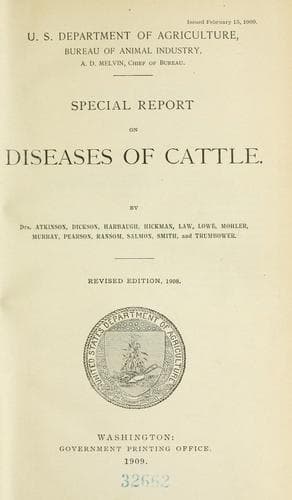
Special report on diseases of cattleUnited States. Bureau of Animal Industry
Science
Special report on diseases of cattle
United States. Bureau of Animal Industry
Cattle -- Diseases
_Symptoms._--A continuous or occasional shivering; the animal lies down,
but appears uneasy; it frequently turns its head toward its belly and lows
plaintively; pressure on the flanks produces pain; has no appetite; muzzle
is dry and no rumination; while standing, its legs are placed well under
its body; pulse small and hard. The evacuations from the bowels are dry and
hard. If this disease is complicated by the presence of inflammation of the
bowels, the pain is more severe and the animal is more restless. The skin
is cold and dry in the early stage of this disease, but in a more advanced
stage this condition may be succeeded by heat of the skin and quick
breathing. The fits of trembling, uneasiness, small and hard pulse, and
tension of the left flank are symptoms the presence of which would enable
one to reach the conclusion that peritonitis exists.
_Post-mortem appearance._--The membrane lining the abdomen and covering the
surface of the bowels is reddened to a greater or less extent, and there is
usually considerable serous, or watery, fluid collected in the abdomen.
_Treatment._--When we have to do with the form of peritonitis resulting
from an injury, as when the horn of another animal has been thrust through
the abdominal walls, this lesion must be treated in accordance with
directions before given, but the general treatment must be similar to that
which follows. Peritonitis resulting from castration or from parturient
fever must also be treated in connection with the special conditions which
give rise to it, as the general treatment of this disease must be modified
to some extent by the exciting cause.
The aim must be to discover and remove the cause. The cause must be treated
according to its nature. Harms strongly recommends borax in the treatment
of peritonitis. He gives 6 ounces in the first 24 hours, divided into three
doses, and afterwards he gives 6 drams three times daily. Opium in doses of
2 to 3 drams may be given. To bring on evacuations of the bowels it is
better to give rectal injections than to administer purges. The strength
may be sustained by coffee or camphor.
The body should be warmly clothed, and it is advisable, when practicable,
to have a blanket which has been wrung out of hot water placed over the
abdomen, then covered by several dry blankets, which are maintained in
position by straps or ropes passing round the body. The wet blanket must be
changed as it cools--the object of treatment being to warm the surface of
the body and to determine as much blood to the skin as possible. The diet
should consist of laxative food and drinks, such as linseed tea. If
peritonitis assumes chronic form the diet should be nutritious, such as
selected clover hay, linseed cake, grass, etc., and iodid of potassium
should be given three times a day in gram doses dissolved in a pint of
water.
DROPSY OF THE ABDOMEN (ASCITES).
In this disease there is a serous, or watery, effusion in the cavity of the
abdomen.
Public-domain text, read in full here on John Shaqi.
Reviews
Reviews
No reviews yet
Be the first to share your thoughts on this work.
Join the Discussion
Join the discussion
Sign in to leave a comment or review.
Sign InorCreate an account