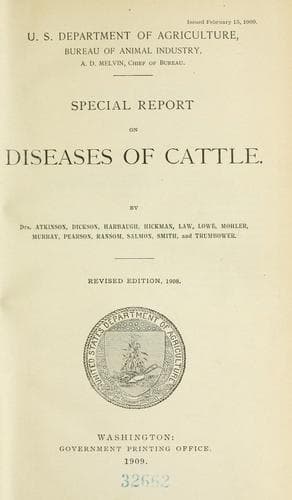
Special report on diseases of cattleUnited States. Bureau of Animal Industry
Science
Special report on diseases of cattle
United States. Bureau of Animal Industry
Cattle -- Diseases
The soluble salts of copper, though used as a tonic in the medicinal
treatment of cattle, are poisonous when taken in large quantities. Like
lead and arsenic, they have an irritant effect upon the mucous membrane
with which they come in contact in a concentrated form. Cattle are not very
likely to be poisoned from this cause unless through carelessness. Sulphate
of copper, commonly called blue vitriol, is occasionally used for
disinfecting and cleansing stables, where it might inadvertently be mixed
with the feed. It is also used largely for making the Bordeaux mixture used
in spraying fruit trees. The general symptoms produced are those of
intestinal irritation, short breathing, stamping, and tender abdomen.
_Treatment._--Give powdered iron, or iron reduced by hydrogen, or calcined
magnesia. Sulphur may be used. This should be followed by a liberal supply
of demulcents, linseed infusion, boiled starch, whites of eggs, etc.
ZINC POISONING.
Several of the soluble salts of zinc are irritant poisons. The chlorid and
sulphate are those in most common use. In animals which have power to vomit
they are emetic in their action. In others, when retained in the stomach,
they set up more or less irritation of the mucous membrane and abdominal
pain, producing symptoms already described in the action of other poisons
which produce the same result.
_Treatment._--The treatment should be the same as for copper poisoning.
PHOSPHORUS POISONING.
Only one of the forms of phosphorus in common use--the ordinary yellow--is
poisonous. Phosphorus in this form is used for the destruction of rats and
mice and other vermin, and has been largely used in the manufacture of
matches.
_Symptoms._--The symptoms are loss of appetite, colic, diarrhea, irritation
of the mouth and throat, and paralysis of the throat. There is also
weakness, difficult breathing, and rapid pulse. The course of the poisoning
is usually rapid, terminating in either recovery or death within three
days. The toxic dose for cattle is from 5 to 30 grains. If taken in large
quantities the excreta are occasionally noticed to be luminous when
examined in the dark.
_Treatment._--Turpentine is given in an emulsion with flaxseed tea in a
single dose of from 2 to 8 ounces. Permanganate of potassium may be given
in a one-fourth of 1 per cent solution. Stimulants, such as alcohol and
ether, should be administered. Oils and milk must not be given.
MERCURY POISONING.
Mercury poisoning is not rare in cattle from the fact that these animals
have a special susceptibility to the action of this substance. Antiseptic
washes or injections containing the bichlorid of mercury (corrosive
sublimate) must be used on cattle with great care. Mercurial disinfecting
solutions or salves must be used cautiously. Calomel can not be given
freely to cattle.
_Symptoms._--The symptoms are salivation, sore mouth, indigestion,
diarrhea, skin eruption, paralysis of local groups of muscles, and
nephritis.
Public-domain text, read in full here on John Shaqi.
Reviews
Reviews
No reviews yet
Be the first to share your thoughts on this work.
Join the Discussion
Join the discussion
Sign in to leave a comment or review.
Sign InorCreate an account