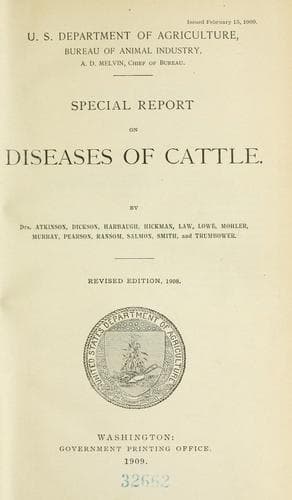
Special report on diseases of cattleUnited States. Bureau of Animal Industry
Science
Special report on diseases of cattle
United States. Bureau of Animal Industry
Cattle -- Diseases
The common brake or bracken fern, _Pteris aquilina_, has been considered
responsible for the poisoning of many horses and cattle. Many cases have
been reported in England and Germany, and some well-authenticated cases in
the United States. Very little has been learned experimentally of fern
poisoning, but there seems to be little question that it has been the cause
of many deaths. The symptoms are said to be temperature higher than normal,
loss of appetite, bloody discharges from mouth, nose, and bowels, and great
depression followed by coma and death. Some authors say that the urine is
colored by blood. It is thought by some that the disease known as "red
water" in the northwestern United States and Canada is caused by eating
ferns.
SORGHUM POISONING.
Under certain conditions sorghum contains enough hydrocyanic acid to make
it exceedingly dangerous to cattle. These cases of poisoning most commonly
occur when cattle are pastured upon the young plant or upon a field where
the crop has been cut and is making a second growth. Conditions of drought
make the sorghum especially dangerous. There is some reason to think that
the frosted second growth is particularly rich in hydrocyanic acid. The
cases of poisoning occur when animals are grazed upon the plant, but not
from the harvested crop or from silage. If cattle are grazed on sorghum or
sorghum stubble they should at first be under constant observation and
should be removed as soon as any signs of illness appear. Similar
precautions should be used in grazing kafir.
CORNSTALK DISEASE.
Considerable losses of cattle have occurred when they were turned upon
cornfields in the fall. Deaths come very suddenly and there is no
opportunity to apply remedies. It has been thought that these fatalities,
like those from sorghum, were caused by hydrocyanic acid, but there is good
reason to think that this is not true, and at the present time there is no
accepted explanation of this disease, although there seems to be no doubt
that it is connected in some way with the condition of the corn. Whether a
given field is poisonous or not can only be determined by experiment, and
the wise farmer will keep his cattle under close observation when they are
first turned into a cornfield.
WATER HEMLOCK (CICUTA).
This plant, growing in wet places by ditches and along creeks, is the most
poisonous of North American plants. The root is the poisonous part, and
cattle generally get it when it is plowed up or washed out by high water.
Sometimes they pull it up, for the plant occasionally grows out into
ditches so that the whole plant will be taken in grazing. The most marked
symptoms of Cicuta poisoning are the violent convulsions, which remind one
of the effect of strychnin.
_Treatment._--Little can be done in the way of treatment. The logical thing
is to attempt to control the convulsions by means of morphia, but in view
of the fact that the stomach can not be emptied, the prognosis is not good,
and most cases die.
Public-domain text, read in full here on John Shaqi.
Reviews
Reviews
No reviews yet
Be the first to share your thoughts on this work.
Elsewhere in the archive
Join the Discussion
Join the discussion
Sign in to leave a comment or review.
Sign InorCreate an account