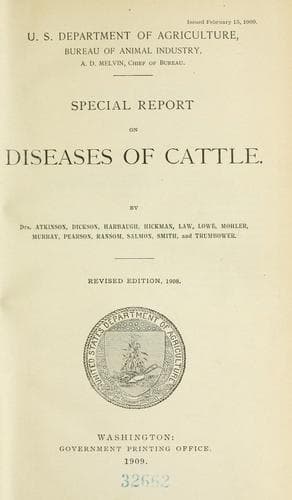
Special report on diseases of cattleUnited States. Bureau of Animal Industry
Science
Special report on diseases of cattle
United States. Bureau of Animal Industry
Cattle -- Diseases
Many of the milkweeds have long been known to have more or less poisonous
properties. Within the last few years it has been discovered that certain
of the milkweeds going under the popular name of whorled milkweeds are
especially toxic. There are at least four species of whorled milkweeds, but
two of them are particularly important from the standpoint of people
handling livestock. One, known scientifically as _Asclepias galioides_, is
harmful in Colorado, Utah, Arizona, and New Mexico, while another, known as
_Asclepias mexicana_, has produced losses, especially in California and
Nevada. These whorled milkweeds are distasteful to all animals and are
eaten only when the stock is closely confined to pastures where there is
little else in the way of forage.
_Symptoms._--The most prominent symptoms are weakness, producing
staggering, and this is followed in acute cases by violent spasms.
_Treatment._--There is no treatment which will effectively antidote the
effect of the poison. In practically all cases, however, poisoning may be
avoided if care is taken to prevent animals from being closely confined
where this plant is abundant, as they never eat the plant by choice.
CHERRY.
In the leaves of the cherries more or less hydrocyanic acid is produced,
and when these leaves are eaten in any considerable quantity cases of
poisoning are likely to arise. It is popularly supposed that these cases
arise from eating wilted cherry leaves, but there is every reason to think
that the fresh leaves will produce the same results. These cases are easily
prevented, because no harm results from eating a small quantity of the
leaves, and if the fact is recognized that poisoning may result from eating
a large quantity, it is not difficult to care for the animals so as to
prevent poisoning.
ERGOTISM.
The poisonous effects of ergot (Pls. V, VI) appear chiefly in the winter
and spring of the year and among cattle. It is developed among grasses
grown on rich soil in hot, damp seasons. Rye seems more liable to ergot
than any of our other crops. Of the grasses which enter into the
composition of hay, bluegrass is the most likely to become affected. Ergot
may also affect redtop, oats, grasses, and grains. On the plant the fungus
manifests itself on the seeds, where it is easily recognized when the hay
is examined in the mow. The ergotized seeds are several times larger than
the natural seeds--hard, black, and generally curved in shape.
Public-domain text, read in full here on John Shaqi.
Reviews
Reviews
No reviews yet
Be the first to share your thoughts on this work.
Elsewhere in the archive
Join the Discussion
Join the discussion
Sign in to leave a comment or review.
Sign InorCreate an account