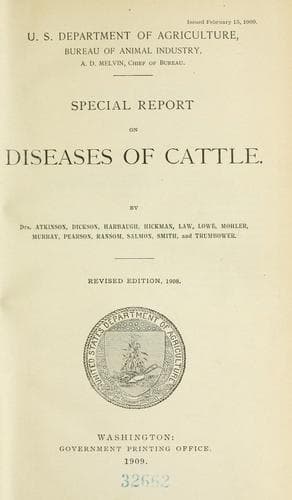
Special report on diseases of cattleUnited States. Bureau of Animal Industry
Science
Special report on diseases of cattle
United States. Bureau of Animal Industry
Cattle -- Diseases
_Symptoms._--Loco poisoning is a chronic condition and symptoms are shown
only after somewhat prolonged feeding. The condition is one of cumulative
poisoning, and animals sometimes decline very rapidly after the first
symptoms appear. In many cases animals acquire a habit of eating loco and
prefer it to any other feed. The poison affects the central nervous system.
There is a lack of muscular coordination and the animal performs very
erratic movements. In the later stages the animal becomes emaciated and
eventually dies of starvation.
_Treatment._--Locoed animals are badly constipated, and it is important
that this condition should be remedied at the start. Any purgative can be
used, but Epsom salt has been found especially effective. If locoed animals
can be turned into a field of alfalfa, a large proportion of them will
recover with no further treatment. Recovery may be aided by giving cattle,
hypodermically, daily doses of three-twentieths to four-twentieths of a
grain of strychnin. By this treatment cattle can be cured and put in
condition for market.
WHITE SNAKEROOT (EUPATORIUM URTIC∆FOLIUM).
White snakeroot, frequently known as "rich weed," is a plant growing in
great abundance in some of the eastern and central regions of the United
States. It is particularly abundant in parts of Ohio, Indiana, and
Illinois, and in western North Carolina. It is responsible for most, if not
all, of the cases of a disease which is commonly known as "milk sickness."
_Symptoms._--The animals are constipated, sometimes have bloody feces,
become weak, and exhibit muscular trembling. This trembling is very
characteristic, so that the disease is sometimes known as "the trembles."
_Remedy._--There are no remedies which will work very efficiently. It is
desirable to give the animals purgatives like Epsom salt and, of course, to
remove them from fields where this plant is abundant.
RAYLESS GOLDENROD (ISOCOMA WRIGHTII).
The rayless goldenrod is a plant growing in especial abundance in parts of
the Pecos Valley in New Mexico and Arizona, and there produces a disease so
much like that produced in the East by white snakeroot that it is sometimes
called milk sickness. More generally this disease goes under the name of
"alkali disease." The plant has produced heavy losses in the regions where
it grows abundantly.
_Symptoms._--The symptoms are much like those produced by the white
snakeroot. The animals are constipated, sometimes have bloody feces, become
weak, and exhibit muscular trembling. There is good reason to think, too,
that the milk of cows eating this plant is more or less injurious.
_Treatment._--A purgative like Epsom salt will aid an animal in recovering,
but most important is to remove the cattle from pastures where the plant is
abundant and give them an abundance of good forage. Under such conditions
they are almost certain to recover.
MILKWEEDS.
Public-domain text, read in full here on John Shaqi.
Reviews
Reviews
No reviews yet
Be the first to share your thoughts on this work.
Elsewhere in the archive
Join the Discussion
Join the discussion
Sign in to leave a comment or review.
Sign InorCreate an account