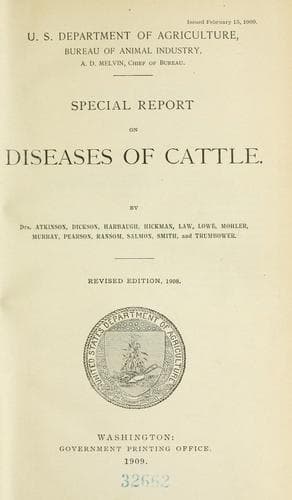
Special report on diseases of cattleUnited States. Bureau of Animal Industry
Science
Special report on diseases of cattle
United States. Bureau of Animal Industry
Cattle -- Diseases
The lymphatics, or absorbents, are the vessels which carry the lymph and
chyle in the blood. They begin as capillaries in all parts of the body,
gradually uniting to form larger trunks. Placed along the course of the
lymphatic vessels are glands, in some situations collected into groups; for
example, in the groin. These glands are often involved in inflammation
arising from the absorption of deleterious matter.
Absorption is the function of the lymphatics. The liquor sanguinis passes
from the blood capillaries to supply nutrition to the tissues. All of the
liquor sanguinis that is not required is absorbed by the lymphatic vessels
and conveyed back to the blood by the lymphatic ducts. The lymphatics which
proceed from the intestines convey the chyle into the blood during
digestion. As a rule, the lymphatic vessels follow the course of the veins.
All the absorbent vessels convey their contents to the thoracic duct and
right great lymphatic vein, which empty into the anterior vena cava, where
the lymph and chyle mix with the venous blood, and thus maintain the supply
of nutritive elements in the blood.
THE PULSE.
As fully explained, the heart pumps the blood throughout the arterial
system. The arteries are always full and each contraction of the ventricle
pumps more blood into them; this distends their elastic walls and sends
along them a wave which gradually becomes less perceptible as it nears the
very small arteries. This wave constitutes the pulse, and is lost before
the capillaries are reached. The sensation or impression given to the
finger when placed upon the artery shows the force exerted by the heart and
some important facts concerning the condition of the circulation. In adult
cattle the average number of pulsations in a minute is from 50 to 60. The
pulse is faster than normal after exercise, excitement, on hot days, from
pain, and as a result of fullness of the stomach. In old animals it is
slower than in the young and in males slightly slower than in females. In
fevers and inflammations and in local diseases of the heart the pulse rate
is increased. If the rate is greater than 100 or 110 to the minute the
outlook for recovery is not good.
Other variations of the pulse are known as infrequent pulse, which means
that the number of pulsations in a given time is less than normal. The
irregular or the intermittent pulse is when the pulsations do not follow in
regular order. The large pulse and the small pulse refer to the volume of
the pulse, which may be larger or smaller than usual. The strong pulse and
the feeble pulse refer to the strength or weakness of the pulsation. The
pulse is said to be hard when the vessel feels hard and incompressible, the
soft pulse being the opposite. By dicrotic pulse is meant that kind of
pulsation which makes each beat seem double, and therefore it is generally
called the double pulse.
Public-domain text, read in full here on John Shaqi.
Reviews
Reviews
No reviews yet
Be the first to share your thoughts on this work.
Elsewhere in the archive
Join the Discussion
Join the discussion
Sign in to leave a comment or review.
Sign InorCreate an account