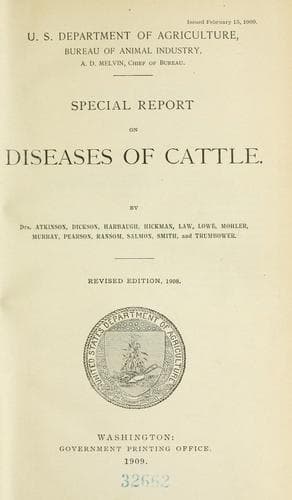
Special report on diseases of cattleUnited States. Bureau of Animal Industry
Science
Special report on diseases of cattle
United States. Bureau of Animal Industry
Cattle -- Diseases
The venous or "jugular pulse" is the pulsation so frequently observed in
the jugular vein of cattle and is particularly noticeable while they are
ruminating--"chewing the cud." It is not always associated with disease,
but may be a symptom of some disease of the heart; in such cases the
jugular pulse is continuous.
The place selected for feeling the pulse in cattle is where the
submaxillary artery winds around the lower jawbones, just at the lower edge
of the flat muscle on the side of the cheek; or, if the cow is lying down,
the metacarpal artery on the back part of the fore fetlock is very
convenient for the purpose.
THE EXAMINATION OF THE HEART.
Corresponding to the beats of the heart two sounds are emitted which are of
a definite type in healthy animals. The first is produced by the
contraction of the heart and the flow of blood out of it; the second is
caused by the rebound of blood in the aorta and the closure of the valves
that prevent it from flowing backward into the heart, whence it came. The
first sound is the longer and louder of the two, though of low pitch. The
second sound is sharper and shorter, and is not always easy to hear. There
is a brief interval between them.
To distinguish these sounds, the ear is placed against the left side of the
chest, a little above the point where the elbow rests when the animal is
standing in a natural position, and about opposite the sixth rib. Both
heart sounds are reduced in intensity when the animal is weak or when the
heart is forced away from the chest wall by collections of fluid or by
tubercular or other growths. Nonrhythmical heart sound is often caused by
pericarditis or by disease of the valves. It may also be attributable to
overfilling of the heart upon the right side, as occurs in severe
congestion of the lungs and in some febrile diseases.
In pericarditis, sounds like scraping, rubbing, or splashing may be heard,
entirely apart from the two normal sounds above described.
The impulse of the heart, as felt by placing the hand against the chest, is
of some consequence in reaching a conclusion in respect to disease of the
heart; but it must be remembered that the impulse may be very much
increased by diseases other than those of the heart, as, for example,
inflammation of various organs, severe pains, etc. The impulse may be
increased also (when disease does not exist) by work, exercise, fright, or
any cause of excitement, or, in general, by anything that causes
acceleration of the pulse.
The impulse of the heart may be felt and the sounds may be heard fairly
well in lean cattle, but in fat ones it is difficult and often impossible
to detect either impulse or sound with any degree of satisfaction.
PALPITATION.
Public-domain text, read in full here on John Shaqi.
Reviews
Reviews
No reviews yet
Be the first to share your thoughts on this work.
Elsewhere in the archive
Join the Discussion
Join the discussion
Sign in to leave a comment or review.
Sign InorCreate an account