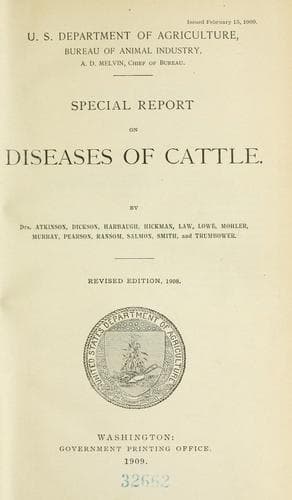
Special report on diseases of cattleUnited States. Bureau of Animal Industry
Science
Special report on diseases of cattle
United States. Bureau of Animal Industry
Cattle -- Diseases
When the impulse of the heart is excessive--that is, when it beats more or
less tumultuously--the familiar expression "palpitation of the heart" is
applied; by many it is called "thumps." The hand or ear placed against the
chest easily detects the unnatural beating. In some cases it is so violent
that the motion may be seen at a distance. Palpitation is but a symptom,
and in many instances not connected with disease of the structure of the
heart or its membranes. A badly frightened animal may have palpitation.
When it comes on suddenly and soon passes away, it depends on some cause
other than diseases of the heart; when it is gradually manifested, however,
and becomes constant, although more pronounced at one time than another,
heart disease may be suspected, especially if other symptoms of heart
disease are present.
INJURY TO THE HEART BY FOREIGN BODIES.
Cattle are addicted to the habit of chewing and swallowing many objects not
intended as articles of food. Every veterinarian of experience has met with
instances to remind him of this, and it is well known to butchers. Among
the great variety of things that have thus found their way into the
stomachs of cattle the following have been noticed: Finger rings, knitting
needles, old shoes, table knives, wood, pieces of leather, pieces of wire,
buttons, hairpins, brushes, nails, coins, etc. The more sharply pointed
objects sometimes penetrate the wall of the stomach, in some cases causing
gastric irritation enough to produce indigestion, gradually work their way
through the diaphragm toward the heart, pierce the pericardium (bag
inclosing the heart), wound the heart, and thus prove fatal to the animal.
Cases are recorded in which the foreign body has actually worked its way
into one of the cavities of the heart. Instances are known, however, in
which the object took a different course, and finally worked its way toward
the surface and was extracted from the wall of the chest. While it is
possible that the foreign body may pierce the wall at different parts of
the alimentary canal, as it frequently does that of the rumen (paunch), it
is thought that in most cases it passes through the wall of the reticulum
(smaller honeycombed compartment, or second stomach) and is drawn toward
the heart by the suctionlike action of the chest. Post-mortem examinations
have demonstrated the course it pursued, as adhesions and other results of
the inflammation it caused were plainly to be seen. All manner of symptoms
may precede those showing involvement of the heart, depending upon the
location of the foreign body and the extent of inflammation caused by it.
Severe indigestion may occur; stiffness and difficulty in moving about
owing to the prods of the sharp body following muscular contraction; pain
on pressure over the front, lower, or right side of the abdomen; coughing
and difficult, quick breathing. In most cases the foreign body does not
penetrate to the heart, nor even to the pericardium.
Public-domain text, read in full here on John Shaqi.
Reviews
Reviews
No reviews yet
Be the first to share your thoughts on this work.
Elsewhere in the archive
Join the Discussion
Join the discussion
Sign in to leave a comment or review.
Sign InorCreate an account