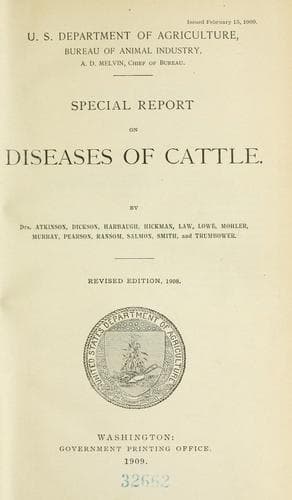
Special report on diseases of cattleUnited States. Bureau of Animal Industry
Science
Special report on diseases of cattle
United States. Bureau of Animal Industry
Cattle -- Diseases
_Symptoms._--The general symptoms are those of heart weakness, accompanied
with edema and congestion of the lungs.
_Treatment._--Relief is sometimes afforded, but usually only temporarily,
by the use of stimulants, especially digitalis.
RUPTURE OF THE HEART.
Sudden effort, blows, or disease may lead to rupture of the heart of the
ox. The first cause does not operate so often in cattle as in horses.
Tuberculosis or ulceration from other causes, such as a foreign body, is
the most common source of this accident. Rupture is shown by sudden
fainting, followed very shortly by death.
HYPERTROPHY AND DILATATION OF THE HEART.
This is an enlargement of the heart, and may consist of the thickening of
the walls alone, or at the same time the cavities may be either enlarged or
diminished. Dilatation of the cavities has been noticed as existing
independently of thickened walls. In hypertrophy the sounds of the heart
are loud and pronounced, may be heard on both sides of the chest
distinctly, and palpitation occurs to a greater or less extent. Fortunately
both conditions are very rare in cattle.
ATROPHY.
Atrophy is the technical term for wasting of the muscular tissue. Atrophy
of the heart is very rare among cattle, and is usually a result of other
diseases.
FATTY DEGENERATION OF THE HEART.
This condition of the heart is met with in some very fat cattle, but it
must be understood that the accumulation of fat around the heart is not
referred to by this designation. In fatty degeneration the elements of the
muscular tissue are replaced by fatty or oily granules. The muscle becomes
weak, the heart contractions are insufficient, and heart weakness is shown
by general weakness, shortness of breath, and weak, rapid pulse.
CYANOSIS.
Owing to the most prominent symptoms, cyanosis is also called "blue
disease," and is seen occasionally in new-born calves. It is recognized by
the blue color of the mucous membrane (easily seen by looking within the
mouth and nostrils), the coldness of the surface of the body, and rapid,
labored breathing. It is caused by non-closure of the foramen ovale,
connecting the right with the left side of the heart, and the consequent
mixing of the venous with the arterial blood. Calves so affected live but a
short time.
MISPLACEMENT OF THE HEART.
Cases are recorded in which the heart has been found out of its natural
position, sometimes even outside the chest. This is a congenital condition
for which there is no remedy. A heifer calf with the heart entirely outside
the thoracic cavity and beneath the skin in the lower part of the neck was
kept for two years at the veterinary hospital of the University of
Pennsylvania, during which time it grew to be a well-developed cow.
WOUNDS OF ARTERIES AND VEINS.
Public-domain text, read in full here on John Shaqi.
Reviews
Reviews
No reviews yet
Be the first to share your thoughts on this work.
Elsewhere in the archive
Join the Discussion
Join the discussion
Sign in to leave a comment or review.
Sign InorCreate an account