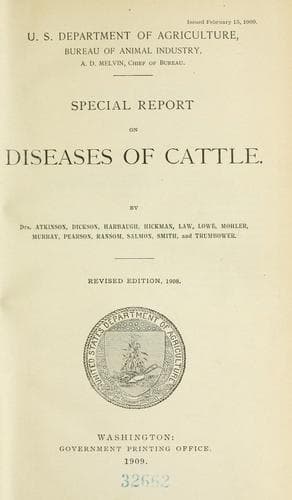
Special report on diseases of cattleUnited States. Bureau of Animal Industry
Science
Special report on diseases of cattle
United States. Bureau of Animal Industry
Cattle -- Diseases
When a blood vessel is opened a glance will tell whether it is an artery or
a vein by simply remembering that bright-red blood comes from arteries and
dark-red from veins. When a vein or a very small artery is severed the
blood flows from the vessel in a continuous and even stream, but when one
of the larger arteries is severed the blood comes in intermitting jets or
spurts corresponding to the beats of the heart. It is well to call
attention to the fact that the dark-red blood which flows or oozes from a
wound soon becomes bright red, because it gives up its carbonic-acid gas to
the air, and absorbs oxygen gas from the air, which is exactly the change
it undergoes in the capillaries of the lungs.
The general treatment of wounds will be found in another section; here it
is necessary only to refer briefly to some of the most practical methods
used to arrest hemorrhages, as instances occur in which an animal may lose
much strength from the loss of blood, or even bleed to death unless action
is prompt.
BLEEDING (HEMORRHAGE).
The severity of a hemorrhage depends upon the size of the vessel from which
the blood escapes, though it may be stated that it is more serious when
arteries are severed. If the wound in an artery is in the direction of its
length, the blood escapes more freely than if the vessel is completely
severed, because in the latter instance the severed ends retract, curl in,
and may aid very much in arresting the flow. When the blood merely oozes
from the wound, and even when it flows in a small stream, the forming of
the clot arrests the hemorrhage in a comparatively short time.
Slight hemorrhages may be checked by the continuous application of cold
water, ice, or snow, to the wound, as cold causes contraction of the small
vessels. Water from a hose may be thrown on a wound, or dashed on it from
the hand or a cup, or folds of cotton cloths may be held on it and kept
wet. Ice or snow may be held against the wound, or they may be put into a
bag and conveniently secured in position.
Hot water of an average temperature of 115∞ to 120∞ F. injected into the
vagina or womb is often efficient in arresting hemorrhages from those
organs. Tow, raw cotton, lint, or sponges may be forced into a wound and
held or bound there with bandages. This is an excellent method of checking
the flow of blood until the arrival of an expert. If the flow persists,
these articles may be saturated with tincture of iron, but it is not
advisable to use it unless necessary, as it is a caustic and retards
healing by causing a slough. In cases of necessity, the articles may be
saturated with vinegar, or tannic acid or alum dissolved in water may be
used instead. Whatever article is used should be left in the wound
sufficiently long to make sure that its removal will not be followed by a
renewal of the hemorrhage. Sometimes it must remain there one or two days.
Public-domain text, read in full here on John Shaqi.
Reviews
Reviews
No reviews yet
Be the first to share your thoughts on this work.
Elsewhere in the archive
Join the Discussion
Join the discussion
Sign in to leave a comment or review.
Sign InorCreate an account