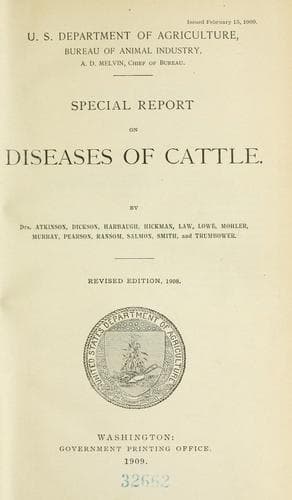
Special report on diseases of cattleUnited States. Bureau of Animal Industry
Science
Special report on diseases of cattle
United States. Bureau of Animal Industry
Cattle -- Diseases
An iron heated white and then pressed on the bleeding vessel for three or
four seconds is occasionally used. It should not be applied longer, or else
the charred tissue will come away with the iron and thus defeat the purpose
of its application.
Compression may be applied in different ways, but only the most convenient
will be mentioned. To many wounds bandages may easily be applied. The
bandages may be made of linen, muslin, etc., sufficiently wide and long,
according to the nature of the wound and the region to be bandaged. Bed
sheets torn in strips the full length make excellent bandages for this
purpose. Cotton batting, tow, or a piece of sponge may be placed on the
wound and firmly bound there with the bandages.
Many cases require ligating, which is almost entirely confined to arteries.
A ligature is a piece of thread or string tied around the vessel. Veins are
not ligated unless very large (and even then only when other means are not
available) on account of the danger of causing phlebitis, or inflammation
of a vein. The ligature is tied around the end of the artery, but in some
instances this is difficult and it is necessary to include some of the
adjacent tissue, although care should be taken not to include a nerve. To
apply a ligature, it is necessary to have artery forceps (tweezers or small
pincers may suffice) by which to draw out the artery in order to tie the
string around it. To grasp the vessel it may be necessary to sponge the
blood from the wound so that the end will be exposed. In case the end of
the bleeding artery has retracted, a sharp-pointed hook, called a
tenaculum, is used to draw it out far enough to tie. The ligature should be
drawn tightly, so that the middle and internal coats will be cut through.
Another method of checking hemorrhage is called torsion. It consists in
catching the end of the bleeding vessel, drawing it out a little, and then
twisting it around a few times with the forceps, which lacerates the
internal coats so that a check is effected. This is very effectual in small
vessels, and is to be preferred to ligatures, because it leaves no foreign
body in the wound. A needle or pin may be stuck through the edges of the
wound and a string passed around between the free ends and the skin (Pl.
XXVII, fig. 10), or it may be passed around in the form of a figure 8, as
is often done in the operation of bleeding from the jugular vein.
ANEURISM.
Public-domain text, read in full here on John Shaqi.
Reviews
Reviews
No reviews yet
Be the first to share your thoughts on this work.
Elsewhere in the archive
Join the Discussion
Join the discussion
Sign in to leave a comment or review.
Sign InorCreate an account