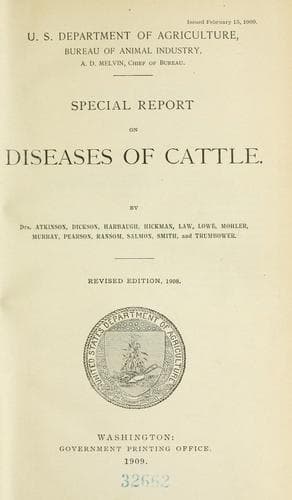
Special report on diseases of cattleUnited States. Bureau of Animal Industry
Science
Special report on diseases of cattle
United States. Bureau of Animal Industry
Cattle -- Diseases
The general physical condition and attitude of the sick animal tell the
careful observer much that aids him in making a diagnosis and prognosis.
Cows suffering from affections of the organs of respiration usually assume
a position or attitude that is characteristic, well known to experienced
stockmen, as well as to veterinarians. When an animal has a fever or is
suffering from an inflammation, the skin is one of the first parts to
undergo a change that is apparent to the average observer, for it soon
loses its elasticity and tone, and the hair becomes dry and staring.
From the general condition or state of nutrition one is able to judge the
effect that the disease has already had upon the animal and to estimate the
strength remaining available for its restoration to health; from the degree
of emaciation one can approximate the length of time the animal has been
ill. The age and breed of the animal, as well as its constitution and
temperament, are among the things that have to be taken into account in
making a diagnosis and in overcoming the disease.
_The mucous membrane._--The mucous membrane should in all cases be
examined. It can be readily seen by everting the eyelids or by an
inspection of the lining membrane of the nostrils.
Paleness of the mucous membrane indicates weak circulation or poor blood
and may result from disease, hemorrhage, or from inappropriate feed.
In healthy animals increased redness of the mucous membrane occurs from
pain, excitement, or severe exertion, and in such instances is always
transitory. In certain pathological conditions, such as fevers and
inflammation, this condition of the mucous membrane will also be found. The
increased redness of the mucous membrane lasts during the duration of the
fever or inflammation.
A bluish or blue mucous membrane indicates that the blood is imperfectly
oxidized and contains an excess of carbon dioxid, and is seen in serious
diseases of the respiratory tract, such as pneumonia, and in heart failure.
_The secretions._--The secretions may be diminished, increased, or
perverted. In the early stage of an inflammation of a secretory organ its
secretion is diminished. In the early stage of pleurisy the serous membrane
is dry, and as the disease advances the membrane becomes unnaturally moist.
The products of secretion are sometimes greatly changed in character from
the secretion in health, becoming excessively irritant and yielding
evidence of chemical and other alterations in the character of the
secretion.
Public-domain text, read in full here on John Shaqi.
Reviews
Reviews
No reviews yet
Be the first to share your thoughts on this work.
Elsewhere in the archive
Join the Discussion
Join the discussion
Sign in to leave a comment or review.
Sign InorCreate an account