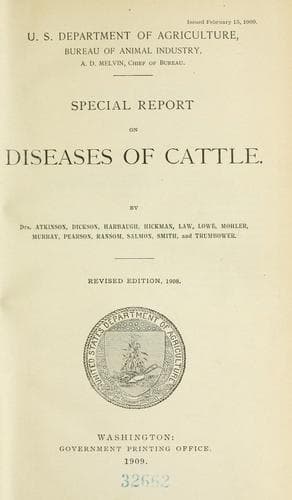
Special report on diseases of cattleUnited States. Bureau of Animal Industry
Science
Special report on diseases of cattle
United States. Bureau of Animal Industry
Cattle -- Diseases
In the determination of disease in the human being the physician, in making
his diagnosis, is aided by both subjective and objective symptoms, but the
veterinary physician, in a very large majority of cases, is obliged to rely
almost solely upon objective symptoms, and perhaps in no class of diseases
is this more true than in the exploration of those under consideration.
This condition of affairs has a strong tendency to develop observation and
discernment in the veterinarian, and not infrequently do we find that the
successful veterinary practitioner is a very accurate diagnostician. In
order to make a differential diagnosis, however, it is not only necessary
to know the structure and functions of the organs in health, but to adopt a
rigid system of details of examination, without which successful results
can not be reached.
_History._--The history of a case should always be ascertained so far as
possible. The information obtained is sometimes unsatisfactory and not to
be depended upon, but even when this is the case it is advisable to weigh
the evidence from every point of view.
In connection with the history of every case it is always of primary
importance to ascertain the cause of illness. A knowledge of the origin and
development of a disease is important, both in making a diagnosis and in
formulating the treatment. Exposure to cold and dampness is frequently the
exciting cause of affections of the organs of respiration.
The experienced practitioner is always sure to ascertain whether the
particular animal he is called on to attend is the only one in the stable
or on the premises that is similarly affected. If several animals are
similarly affected, the disease may have a common cause, which may or may
not be of an infectious nature.
Another thing that the experienced practitioner ascertains is what previous
treatment, if any, the animal has had. Medicine given in excessive doses
sometimes produces symptoms resembling those of disease.
The hygienic and sanitary conditions must always be considered in
connection with the cause as well as the treatment of disease. Much of the
disease which occurs in large dairies and elsewhere could be prevented if
owners and those in charge of animals had proper regard for the fundamental
laws of animal hygiene and modern sanitation. Disregard for these laws is
the cause of most of the diseases under consideration in this chapter.
_Attitude and general condition._--The feeling of pain in animals suffering
from serious affections of the organs of respiration is expressed to the
close observer in no uncertain language--by their flinching when the
painful part is touched; by the care with which they move or lie down; by
walking or standing to "favor" the part; by the general attitude and
expression of the eye; by the distress and suffering apparent in the face;
and by other evidences.
Public-domain text, read in full here on John Shaqi.
Reviews
Reviews
No reviews yet
Be the first to share your thoughts on this work.
Elsewhere in the archive
Join the Discussion
Join the discussion
Sign in to leave a comment or review.
Sign InorCreate an account