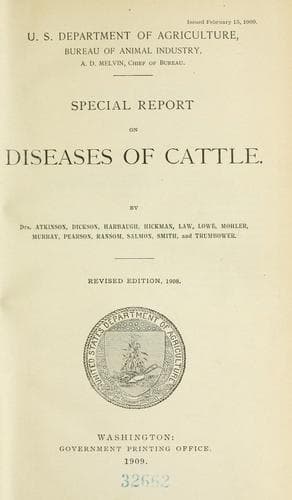
Special report on diseases of cattleUnited States. Bureau of Animal Industry
Science
Special report on diseases of cattle
United States. Bureau of Animal Industry
Cattle -- Diseases
Pleurisy is an inflammation of the serous membrane lining the chest cavity
and enveloping the lungs. It is somewhat rare as an independent disease,
but it often complicates pneumonia; indeed, it is often caused by the same
germ that causes pneumonia--pneumococcus. It may arise from exposure to
cold or wet or from external violence, and is usually present in some
degree in cases in which the ribs have been fractured with or without a
penetrated wound.
_Symptoms._--In the first stage there is great pain aggravated by movement,
and the animal is usually stiff as though foundered, the pulse is quick and
hard, the breathing abdominal, the chest being fixed so far as possible,
the inspiration short and jerky, the expiration longer. The pain is caused
by the friction of the dry, inflamed pleural surfaces of the lung and chest
on each other. At this stage the ear detects a dry friction murmur,
resembling somewhat the sound made by rubbing two pieces of sole leather
together. Pressure between the ribs gives pain and usually causes the
animal to flinch and grunt. The muzzle is hot and dry, the mouth slimy, and
the secretions scanty. After a day or two the severity of the symptoms is
much lessened, the temperature, which during the first days may have been
as high as 106∞ F., falls to 103∞ or 104∞, the pain decreases, the
stiffness disappears, and the patient eats a little. The pulse softens, but
remains quicker than normal. Now, day by day the patient loses a little
strength, the friction sound disappears as the exudation moistens the
pleural surfaces; percussion now shows a horizontal line of dullness, which
day by day rises higher in the chest, the respiration grows more frequent
and labored, the countenance is anxious and haggard, the eyes sink somewhat
in their sockets, and in unfavorable cases death occurs during the second
or third week, from either asphyxia or heart failure.
In pleurisy, as in pneumonia, the elbows are usually turned outward. Care
must be taken to differentiate pleurisy from traumatic pericarditis (which
see). In the latter condition the area of dullness of the heart is much
increased, and usually a splashing sound is heard at each beat of the
heart. Another diagnostic symptom of value is that in traumatic
pericarditis respiration is painful, not difficult, and the respiratory
rate is very much increased on movement. In both conditions a considerable
swelling of the dewlap may be noticed in the later stages.
Public-domain text, read in full here on John Shaqi.
Reviews
Reviews
No reviews yet
Be the first to share your thoughts on this work.
Elsewhere in the archive
Join the Discussion
Join the discussion
Sign in to leave a comment or review.
Sign InorCreate an account