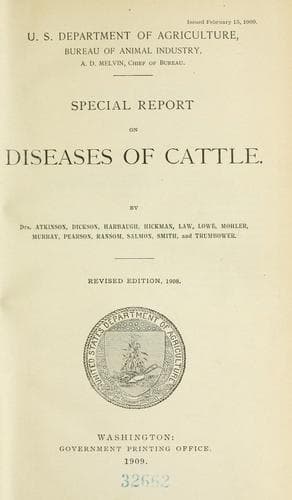
Special report on diseases of cattleUnited States. Bureau of Animal Industry
Science
Special report on diseases of cattle
United States. Bureau of Animal Industry
Cattle -- Diseases
_Treatment._--Give the same general care as recommended in bronchitis or
pneumonia. In the early stages give a febrifuge to reduce the fever, as
directed for pneumonia. For relief of the cough give electuary formula,
which will be found in the treatment of laryngitis. The bowels must be kept
relaxed and the kidneys secreting freely. In the stage of effusion the
following should be given three times daily: Digitalis tincture, 1 ounce;
iodid of potassium, 30 to 60 grains; mix. Apply strong counterirritant to
chest and put seton in dewlap. (See "Setoning," p. 293.) If collapse of the
lung is threatened, a surgical operation, termed paracentesis thoracis, is
sometimes performed; this consists in puncturing the chest cavity and
drawing off a part of the fluid. The instruments used are a small trocar
and cannula, which are introduced between the eighth and ninth ribs. The
skin should be drawn forward so that the external wound may not correspond
to the puncture of the chest, to prevent the entrance of air. Only a
portion of the fluid should be removed. The animal gets immediate relief,
but it is generally only temporary, as the fluid has a tendency to
accumulate again.
PNEUMONIA.
Pneumonia is an inflammation of the lung substance, and is divided into
three forms, viz, croupous, catarrhal, and interstitial. These various
forms, however, can be differentiated only by the expert, and it is
therefore deemed necessary for the purpose of the present work to treat the
subject under the general head of pneumonia.
The causes of pneumonia in general are the same as those of the various
other inflammatory diseases of the respiratory tract. The germ is known as
a pneumococcus. The disease mostly follows congestion of the lungs, but may
in rare cases have a parasitic origin.
_Symptoms._--In the first stage, that of congestion, the disease is usually
ushered in by a chill, although this may not always be observed by the
attendant. This is followed by an elevation of temperature, usually 105∞ to
106∞ F., or it may be even higher. The respirations are quick and shallow;
the nostrils are dilated; the pulse is full and hard. Cough may or may not
appear in this stage. The nose is hot and dry; the tongue sometimes
protrudes and is slimy; the coat is staring, and the skin dry and harsh.
The urine is usually diminished in quantity, high colored, and the bowels
constipated. The animal stands with the forelegs wide apart to facilitate
respiration. On auscultation crepitation will be observed over the portion
of the lung affected. The sounds elicited on percussion are practically
normal in this stage.
Public-domain text, read in full here on John Shaqi.
Reviews
Reviews
No reviews yet
Be the first to share your thoughts on this work.
Elsewhere in the archive
Join the Discussion
Join the discussion
Sign in to leave a comment or review.
Sign InorCreate an account