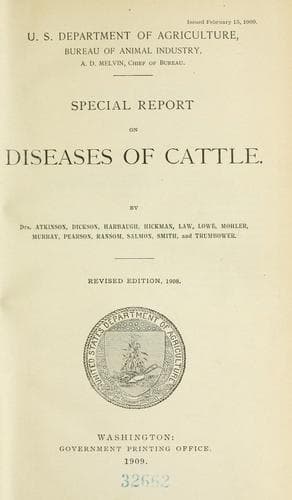
Special report on diseases of cattleUnited States. Bureau of Animal Industry
Science
Special report on diseases of cattle
United States. Bureau of Animal Industry
Cattle -- Diseases
In the second stage the temperature generally drops one or two degrees, and
respiration is performed with much difficulty. The cough is frequent and
painful. The animal still stands with the forelegs wide apart and the
elbows turned outward. If it assumes the recumbent position it rests on the
sternum. All secretions are more or less suspended, particularly the milk
in cows. The animal has a haggard appearance, and the pulse becomes small
and wiry at this period. The extremities are hot and cold alternately; the
crepitation which was present in the first stage is now absent, and no
sound on auscultation is heard, unless it is a slight wheezing or whistling
noise. On percussion dullness over the diseased lung is manifested,
indicating consolidation. The lung has now assumed a characteristic
liverlike appearance.
In the third stage, if the disease is to terminate favorably, the cough
becomes loose, the animal improves, the appetite returns, and the symptoms
above detailed rapidly subside; if, on the other hand, resolution is not
progressing, the lung substance degenerates, becomes clogged up, and ceases
to function. In fatal cases the breath has a peculiar, fetid, cadaverous
odor, and is taken in short gasps; the horns, ears, and extremities become
cold and clammy, and the pulse is imperceptible. On auscultation, when
suppuration is taking place and the lung structure is breaking down, a
bubbling or gurgling crepitation, caused by the passage of air through pus,
is heard.
_Treatment._--Good hygienic surroundings and good nursing are essential in
connection with the medical treatment. The probability of recovery depends
largely on the extent of the lung tissue involved, as well as on the
intensity of the inflammatory process. In the early stage, when the fever
is high, febrifuges should be given. If the pulse be strong and full,
aconite (Fleming's tincture, 1 to 2 drams, every four or five hours) may be
given for a short time, but should be discontinued as soon as the fever
begins to abate. Aconite is a valuable drug in the hands of the intelligent
practitioner, but my experience leads me to believe that not infrequently
animals are lost by its injudicious use, for in many febrile conditions it
is positively contraindicated, owing to its action upon the heart. In a
plethoric animal, with a strong, bounding pulse, bleeding may be resorted
to instead of administering aconite. If the bowels are constipated,
calomel, 1 to 3 drams, which acts as a cathartic and a febrifuge, is
advisable. In the second stage diffusible stimulants are required, viz:
Spirits of nitrous ether, 2 ounces; aromatic spirits of ammonia, 1 ounce;
mix, and give in gruel three times daily. In some cases carbonate of
ammonia, 2 to 5 drams, has been found beneficial. Most practitioners apply
counterirritants, such as mustard plasters, turpentine, and ammonia
liniment, or cantharides.
EMPHYSEMA (HEAVES).
Public-domain text, read in full here on John Shaqi.
Reviews
Reviews
No reviews yet
Be the first to share your thoughts on this work.
Elsewhere in the archive
Join the Discussion
Join the discussion
Sign in to leave a comment or review.
Sign InorCreate an account