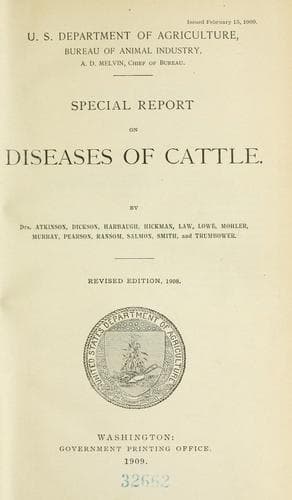
Special report on diseases of cattleUnited States. Bureau of Animal Industry
Science
Special report on diseases of cattle
United States. Bureau of Animal Industry
Cattle -- Diseases
Pleurodynia is a term applied to rheumatism of the intercostal muscles, the
apparent symptoms being very similar to those of pleurisy. The animal is
stiff, is not inclined to turn around, and the ribs are kept in a fixed
state as much as possible. Pleurodynia may be distinguished from pleurisy
by the coexistence of rheumatism in other parts and by the comparative
absence of fever, cough, the friction sound, and the effusion into the
chest. The treatment for this affection is the same as that for rheumatism
affecting other parts.
DISEASES OF THE NERVOUS SYSTEM.
By W. H. HARBAUGH, V. S.
[Revised by John E. Mohler, V. M. D.]
THE NERVOUS SYSTEM.
The nervous system is the distinguishing feature of animal life. Without it
there can be no intelligence, no instinct, no sensibility, no perception;
in fact, existence would be nothing more than vegetable life.
The senses--touch, taste, sight, hearing, smell--all depend on the nervous
system. Motion depends on it. A muscle can not contract without receiving
the stimulus from the nervous system. For example, if a nerve passing from
a nerve center to a muscle is severed, the particular muscle that is
supplied by the cut nerve is paralyzed.
The nervous system is often studied in two divisions--the cerebrospinal
division and the sympathetic division.
The cerebrospinal division consists of the brain and spinal cord, nerves,
and ganglia. The nerves of this division convey the impulses of motion and
sensation and supply all parts which are under the control of the will. For
example, the voluntary muscular tissue includes all the muscles which act
as the will directs. Another example: If anything comes in contact with any
part of the skin, the impression is immediately perceived. All the special
senses belong to this division.
The sympathetic division consists of nerves and ganglia. The muscular
tissue, which acts independently of the will--as, for example, the stomach,
intestines, womb, blood vessels, ducts, etc.--is called involuntary
muscular tissue, and receives nervous stimulus from the sympathetic
division.
Public-domain text, read in full here on John Shaqi.
Reviews
Reviews
No reviews yet
Be the first to share your thoughts on this work.
Elsewhere in the archive
Join the Discussion
Join the discussion
Sign in to leave a comment or review.
Sign InorCreate an account