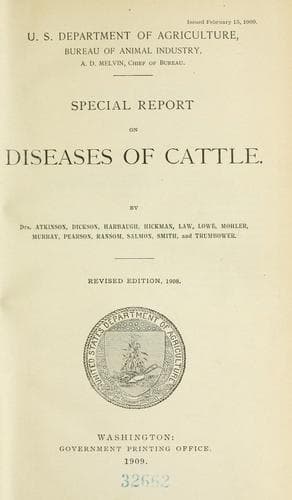
Special report on diseases of cattleUnited States. Bureau of Animal Industry
Science
Special report on diseases of cattle
United States. Bureau of Animal Industry
Cattle -- Diseases
The brain, spinal cord, and the ganglia are the central organs of the
nervous system. The nerves conduct the nervous influence. The nerves
terminate differently according to their function. The terminations are
called end organs. The terminal end organs in the skin and other parts
endowed with sensation receive the impressions, which are conveyed to the
brain, where they are appreciated. They are so sensitive that the most
gentle zephyr is perceived. They are so abundant that the point of the
finest needle can not pierce the skin without coming in contact with them,
and the sensation of pain is instantly conveyed to the brain. The terminal
end organs of the nerves that supply the muscles are different, as they
give the impulse which is conveyed by the motor nerves to the elements
which constitute the muscle, and this impulse is the excitation which
causes the muscle to contract. The terminal end organs of the special
senses of taste, smell, etc., receive their special impressions, and their
respective nerves carry the impressions to the brain.
There are two divisions of nerves, the afferent and efferent.
The afferent nerves are those which convey the impression to the nerve
centers. All the sensory nerves belong to this division.
The efferent nerves are those which convey the nervous impulse outward from
the nerve centers, and they are further classified according to the
function of their respective centers. For example: Motor fibers carry the
impulse from the nerve center to a muscle to cause contraction. Vasomotor
fibers carry the impulse to the muscular tissue in the blood vessels, which
regulates their caliber. The secretory fibers convey the impulse to the
cells of the glands and excite the activity of the gland, and its
particular product is secreted or evolved, as, for instance, milk in the
mammary gland. Inhibitory fibers control or inhibit the action of the organ
to which they are distributed, as, for instance, the heart.
Nerve centers may be considered as a collection or group of nerve cells.
Both the cerebrospinal and the sympathetic divisions have nerve centers.
The centers derive their special names from their functions. The brain is
the great center of the nervous system, as it is the center of intelligence
and perception. The centers of all the special senses, as well as the
centers of various functions, are located in different parts of the brain.
Nerve centers also exist in the spinal cord and in connection with the
sympathetic system.
A nerve is a cord consisting of a certain number of fibers of nerve tissue,
inclosed in a sheath of connective tissue. Nerves divide and subdivide,
sending off branches, which ramify in all parts of the body, and, as they
near their terminations, they contain but one or two fibers.
The brain and spinal cord are contained within a bony canal, which forms a
protective covering for them.
Public-domain text, read in full here on John Shaqi.
Reviews
Reviews
No reviews yet
Be the first to share your thoughts on this work.
Elsewhere in the archive
Join the Discussion
Join the discussion
Sign in to leave a comment or review.
Sign InorCreate an account