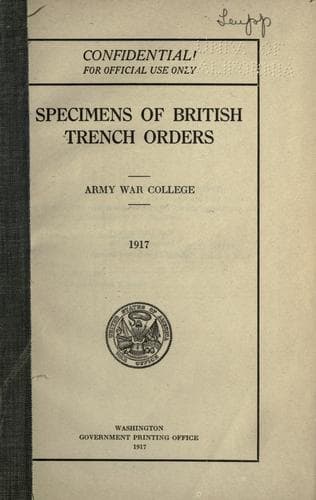
Specimens of British Trench OrdersArmy War College (U.S.)
History
Specimens of British Trench Orders
Army War College (U.S.)
Great Britain. Army; Intrenchments; Military orders; World War, 1914-1918
Any part of trench which receives more than ordinary attention
from the enemy's guns.
Number of bombing posts and bombs at each.
Number of machine guns on company's front.
Work in hand or contemplated.
What artillery covers the front, and how it is best and quickest
obtained.
A list of trench stores, ammunition, etc., will also be drawn up
ready for handing over. All stores should be carefully stacked in a
convenient place. Ammunition, VERY lights, sandbags, etc., sufficient
for at least 24 hours consumption, should invariably be handed over to
the relieving unit.
(_k_) The following constitute trench stores and will be handed over on
relief:
S. A. A.
Shovels.
Picks.
Loophole plates.
Balers.
Fixed rifle batteries.
Sniperscope rifles.
Braziers.
Catapults.
Grenade throwers.
Rifle racks.
Rifle grenade firing stands.
Hand grenades.
Rifle grenades.
VERY pistol cartridges.
Gongs, bells, and alarms.
VERMOREL sprayers.
Pumps.
Reserve rations.
The following will not be handed over:
VERY pistols.
Pistols, illuminating, 1-1/2 inch.
Telescopic rifles.
Periscopes.
Telephones.
Battalion entrenching tools will not be taken to the trenches. Should
the existing tools in the trenches be considered insufficient,
application should be made to brigade headquarters for a further
supply.
=2. SENTRIES.=--As a general rule, the following numbers of sentries
will be posted:
_By day._--One sentry for every 3 bays, exclusive of bombers, snipers,
and machine gunners.
_By night, in a fog or snowstorm._--One double sentry for each bay,
exclusive of bombers and machine gunners.
Sentries will invariably be posted and relieved by a N. C. O. under the
orders of the platoon commander.
It must be recognized that no fixed rules can be laid down as regards
the number of sentries that are necessary and battalion commanders will
use their discretion in the matter. The number required will depend on
the proximity of the enemy, the tactical situation, and, above all, on
the state of our own wire entanglements.
=3. OFFICER AND N. C. Os. OF THE "WATCH."=--In every company in the
firing line the company commander will arrange for his officers to take
it in turns to be on "watch" throughout the twenty-four hours.
Likewise in each platoon the platoon commander will detail a N. C. O.
of the watch.
The officer and N. C. Os. of the watch will visit all sentries, bombing
posts, and machine guns within the area of their command once every
hour by day and by night.
At night the officer of the watch will carry a VERY pistol. VERY lights
should be used sparingly, as they are often difficult to obtain.
The time when lights are most required is when the Germans are not
sending any up.
Public-domain text, read in full here on John Shaqi.
Reviews
Reviews
No reviews yet
Be the first to share your thoughts on this work.
Join the Discussion
Join the discussion
Sign in to leave a comment or review.
Sign InorCreate an account