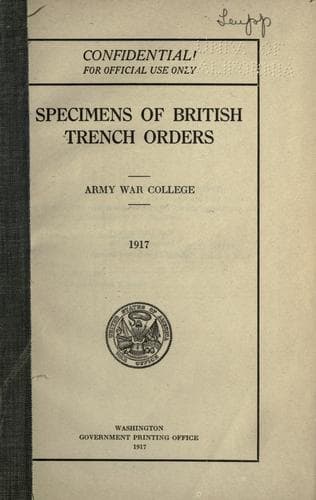
Specimens of British Trench OrdersArmy War College (U.S.)
History
Specimens of British Trench Orders
Army War College (U.S.)
Great Britain. Army; Intrenchments; Military orders; World War, 1914-1918
(x) Rifle bolts and machine-gun crank handles to be worked backwards
and forwards while gas is about, to prevent the gas from impairing the
action.
(xi) Vermorel sprayers to be used in trenches and dugouts in the
affected area as soon as the gas has passed over, in order that gas
helmets may be taken off.
(xii) Measures will be taken to prevent stragglers.
=6. FIXING OF BAYONETS.=--Bayonets will always be fixed during the
hours of darkness, during a snowstorm, or thick mist, or when the
proximity of the enemy renders this course advisable.
=7. COUNTER ATTACKS.=--As soon as possible after taking over a new line
battalion commanders will draw up and submit to brigade headquarters
their scheme for counter attacking the enemy should he gain possession
of any part of their line.
In framing this scheme it must be borne in mind that in every line of
trenches there are certain points which would be of value to the enemy
if captured by him, whereas there are others which would be of little
use to him.
Should the enemy attack and occupy any portion of our trenches he will
be immediately counter attacked and driven out by the nearest body of
troops. All ranks must clearly understand that counter attacks made at
once and without hesitation will usually be sucessful, even if made by
small numbers, but that a counter attack, once the enemy has been given
time to establish himself, is a very difficult and costly operation.
=8. MINES.=--Should the enemy fire a mine in or near our trenches the
crater thus formed will be immediately occupied by the nearest troops.
This order will be made known to all ranks.
=9. FIRING BY DAY AND NIGHT.=--By day men will only fire when a target
offers itself. If the enemy is in the habit of showing himself at any
particular point, the attention of the platoon commander should be
drawn to it. The latter will inform the battalion sniping officer, who
will tell off a sniper's post to watch the spot.
By night all firing must be organized. If the enemy is believed to
be working on his trenches or wire, the company commander will give
directions to his platoon commanders to fire five rounds rapid at
certain stated times. He will first ascertain that no patrols from
neighboring companies will be out at these hours.
A certain number of fixed rifles will be placed in every trench and
fired by the sentries. These rifles will be laid on certain selected
spots.
Indiscriminate firing by day or night is forbidden.
If the enemy attacks, rapid fire will be opened without waiting for
orders.
=10. COMPANY MEETINGS.=--Officers commanding companies will hold
meetings of their platoon commanders and N. C. Os. each evening in the
trenches. Only a few officers and N. C. Os. should be present at each
meeting. At these meetings the following points should be discussed:
Work required to place our trenches in a better state of defense
and to improve the comfort of the men.
Work to be done during the next 24 hours.
Public-domain text, read in full here on John Shaqi.
Reviews
Reviews
No reviews yet
Be the first to share your thoughts on this work.
Join the Discussion
Join the discussion
Sign in to leave a comment or review.
Sign InorCreate an account