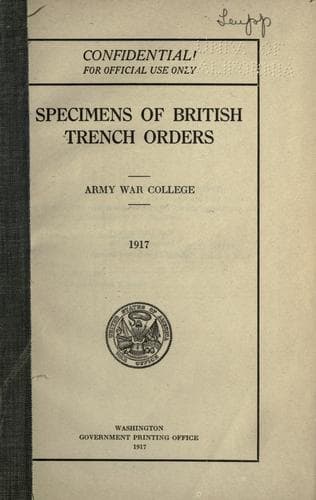
Specimens of British Trench OrdersArmy War College (U.S.)
History
Specimens of British Trench Orders
Army War College (U.S.)
Great Britain. Army; Intrenchments; Military orders; World War, 1914-1918
All aircraft belonging to the enemy will be heavily fired on by machine
guns and rifles as long as they are within range, but no firing will
take place without the order of an officer, who will first satisfy
himself that the aircraft is hostile. Directions should be given to
the men as to how many lengths in front of the aeroplane aim should be
taken. If a "Zeppelin" is sighted, a "priority" message will be sent to
brigade H. Q. reporting the fact and stating approximately where the
"Zeppelin" was seen and in what direction it was proceeding.
=22. MAPS.=--Maps with our own trenches marked on them will not be
taken into the front-line trenches.
=23. TELEPHONE MESSAGES.=--No messages regarding the action of our
own Artillery or other matters of an important nature will be sent by
telephone to the fire trenches. Such messages will be sent by orderly.
This is necessary because it has been found that the enemy has, at
times, read our messages by induction.
=24. SIGNALERS.=--The brigade signaling section is responsible for the
maintenance of communication between brigade H. Q. and battalions.
Battalion signalers are responsible for communications within the
battalion.
All wires must be pinned in to the sides of trenches. Infantry wires on
the S. and E. sides and Artillery wires on the N. and W. sides.
Pins for this purpose can be obtained from brigade headquarters.
All wires will be labeled with the name of the battalion at least every
50 yards.
Officers in charge of battalion signalers are responsible that all
disused or unlabeled wires within their areas are reeled up.
All wires will be patroled at least once every 24 hours.
=25. MEDICAL OFFICERS.=--Medical officers attached to battalions will,
in addition to looking after the sick and wounded, be responsible for
the sanitation of the trenches generally, paying particular attention
to the water supply and latrines. Battalion sanitary sections will work
under the orders of the medical officer.
The medical officer will accompany the commanding officer periodically
on his visits round the trenches.
Stretcher bearers are responsible that the rifles and equipment
(including field glasses, wire cutters, etc.), of all men who are
wounded are taken with them to the dressing station. The medical
officer will instruct the N. C. O. i/c stretcher bearers to see that
this order is carried out.
The arms and equipment of wounded men will be sent to the field
ambulance with them, the ammunition having first been removed from
pouches and magazines. Field glasses, wire cutters, etc., will not be
sent to the field ambulance but will be sent to battalion headquarters.
The arms and equipment of men who are killed will be collected at
battalion headquarters and handed over to the quartermaster for return
to the base.
=26. RATION PARTIES.=--Parties to carry rations, water, and material to
the companies in the front line will be detailed from the companies in
reserve.
Public-domain text, read in full here on John Shaqi.
Reviews
Reviews
No reviews yet
Be the first to share your thoughts on this work.
Join the Discussion
Join the discussion
Sign in to leave a comment or review.
Sign InorCreate an account