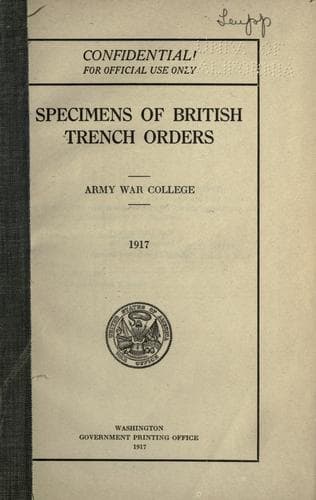
Specimens of British Trench OrdersArmy War College (U.S.)
History
Specimens of British Trench Orders
Army War College (U.S.)
Great Britain. Army; Intrenchments; Military orders; World War, 1914-1918
(_d_) The commanding officer is responsible for sanitation in his unit
and the medical officer will advise him in sanitary matters, making
daily inspections of latrines, refuse pits, and water arrangements.
Under the medical officer latrines and refuse pits will be attended
to by the regimental sanitary men and water duties by the R. A. M. C.
details attached.
=10. TIME-TABLES AND ORGANIZATION OF WORK.=--(_a_) A time-table will be
drawn up by each company commander. In this time-table he will allot
hours of work, rest, and meals.
(_b_) Working parties will be properly organized. Definite tasks will
be allotted. Each commander of a working party should know what work is
expected from his party before the hour appointed to commence, so that
no time is wasted in getting to work.
(_c_) Unless it can not be avoided, men should never be taken for
sentry duty without having had a reasonable period of rest, and when
this becomes necessary a report should be made to the C. O.
=11. LOG BOOKS AND TRENCH STORE BOOKS.=--(_a_) Each company commander
will keep a log book in which will be entered up daily the work done.
This log book will be handed over from one commander to another on
relief.
(_b_) A trench store book will also be kept in which will be entered
up all trench stores issued to the company. On relief, the incoming
company commander will give a receipt to the outgoing commander for all
trench stores taken over.
(_c_) Commanding officers are personally responsible that no trench
stores, bath mats, etc., are used as firewood.
=12. COMMUNICATIONS.=--(_a_) Artillery lines will be laid on one side
of a trench. Infantry lines on the opposite side.
(_b_) The Infantry brigade signal officer will exercise general
supervision over all lines in the brigade area, and will notify the
orderly officer of the Artillery brigade when any Artillery lines
require attention or relaying. He will assist the Artillery whenever it
may be possible to do so.
(_c_) Lines will be laid as low as possible, preferably not more than
9 inches from the bottom of the trench. They will be picketed into
grooves cut into the side of the trench, the pickets being securely
driven in at every reentrant bend and at every 10 yards along the
straight.
(_d_) Lines will be clearly labeled at every 100 yards and at every
junction with another line.
(_e_) All lines will be carefully patrolled at least once daily.
(_f_) One telephonist will always be on duty.
(_g_) Telephone communication to battalion headquarters and the company
on each flank will be frequently tested.
(_h_) All "dead" lines will be reeled up at once.
(_i_) Every man is to know the position of his platoon commander's
shelter and the company headquarters.
(_j_) At least two men per section of the support and reserve companies
must be able to act as guides to all the company headquarters of the
battalion.
Public-domain text, read in full here on John Shaqi.
Reviews
Reviews
No reviews yet
Be the first to share your thoughts on this work.
Join the Discussion
Join the discussion
Sign in to leave a comment or review.
Sign InorCreate an account