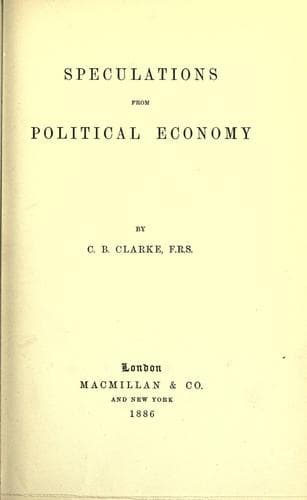
Speculations from Political EconomyClarke, Charles Baron
General
Speculations from Political Economy
Clarke, Charles Baron
Economics
Produced by John Hagerson, Jonathan Ingram, and the Online
Distributed Proofreading Team
SPECULATIONS FROM POLITICAL ECONOMY
By C. B. Clarke, F.R.S.
INTRODUCTION
The following nine articles are "Speculations," by no means altogether
recommendations. They are _from_ Political Economy, i.e. they have
nearly all of them been suggested by considering mere propositions of
Political Economy. Some of them are old, or given me by friends: some
are, I believe, new: these many persons will set aside as unpractical
or impracticable, as that is the approved word by which people indicate
that an idea is new to them. The topics of the nine articles have been
largely taken from those now under political discussion, but they can
hardly be called ephemeral; and, though they do not form a treatise,
they will hardly be called disconnected. As they are speculations, no
trouble has been taken to work out suggestions in detail, or give the
"shillings and pence" correctly.
CONTENTS
1. EFFICIENCY OF LABOUR
2. RECIPROCITY AND RETALIATION
3. UNIVERSAL FREE TRADE
4. THE RANSOM OF THE LAND
5. MAKING THE MOST OF OUR LAND
6. FREE TRADE IN RAILWAYS
7. REFORM IN LAND LAW
8. EQUALISING OF TAXATION
9. WEALTH OF THE NATION
SPECULATIONS _FROM POLITICAL ECONOMY_
1. EFFICIENCY OF LABOUR.
Political economists have not overlooked efficiency of labour: they have
underestimated its importance in the opinion of Edward Wilson, who has
supplied me with the examples and arguments that follow and who has
verbally given me leave to publish as much as I like.
The English workman, especially in a country town of moderate size,
regards capital as unlimited, employment ("work") as limited. A wall six
feet high is to be built along the length of a certain garden: if one
bricklayer is employed, the fewer bricks he lays daily the more days'
employment he will get; if several bricklayers are employed, the fewer
bricks one lays daily the more employment is left for the others. It
thus appears that the more inefficient the labourer is, the better for
himself, his fellow-handicraftsmen, and for "labour" in general: the
more money is drawn from the capitalist.
Public-domain text, read in full here on John Shaqi.
Reviews
Reviews
No reviews yet
Be the first to share your thoughts on this work.
Join the Discussion
Join the discussion
Sign in to leave a comment or review.
Sign InorCreate an account