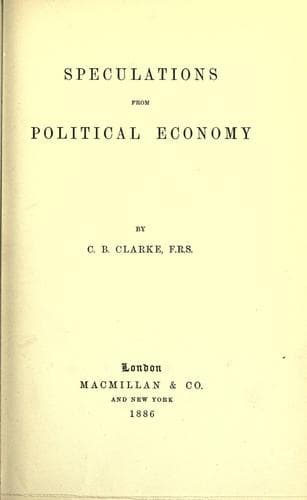
Speculations from Political EconomyClarke, Charles Baron
General
Speculations from Political Economy
Clarke, Charles Baron
Economics
It appears to me that if we wish to convince Europe and America of the
truth of Free Trade (as understood by our political economists), our
proper course is to adopt Free Trade ourselves FULLY (if the principle
is good for wheat it is good for tea--I shall return to this), and then
to say to foreigners, "See how we prosper under Free Trade." If the
Americans continue to maintain Protectionist duties on our manufactures,
our line of conduct is not to offer to pay them indirectly to relax
those duties, but to say, "You are losing more by your duties than we
are; the proof of the pudding is in the eating." If I believe, as I do,
that the Americans are gaining less wealth under Protection than they
would under Free Trade, I cannot imagine any plan less likely to convert
them to my views than my going to them and saying, "We will give you
£5,000,000 sterling (or some valued political advantage) if you
will alter your mistaken policy." If this course did not confirm the
Americans in the very deepest suspicions that Protection is really
advantageous to them, and that we in our inmost heart think so too, my
ideas of human nature are altogether at fault. But every foreign debate,
whether in France, Germany, or America, on Free Trade, convinces me
that I am not mistaken in the effect which I attribute to our prayers to
every foreign nation to grant us a Commercial Treaty.
3. UNIVERSAL FREE TRADE.
Wheat is now admitted to England free of duty. Tea pays a duty of about
£4,000,000 sterling a year. This is called a duty for revenue, not for
protection. Tea is an article of universal consumption; the tax on it is
open to the objections against a poll tax or hearth tax, viz. that by it
many a poor old woman is taxed as heavily as far richer people; indeed,
owing to the poor consuming the lower-priced teas, they are by the
present duty taxed at a higher rate than those who can afford the more
expensive teas.
The reply in defence of these anomalies is, "We have to raise £4,000,000
sterling by a duty on something; on whatever we put it, it will no doubt
be bad." Granting, however, this for a moment, the onus lies on the
defender of the existing tariff to prove that it is better to raise
the £4,000,000 required from tea than from wheat, or than to raise
£2,000,000 from tea, £2,000,000 from wheat. Mr. Raban, a leading
tea-planter in Assam, has observed that if the duty on tea was replaced
by one on wheat to raise the same gross amount, the pressure on the
English poor would be less; while an encouragement would thus be given
both to tea-planting in India and to agriculture in England. I adduce
this case of the duty on tea merely to bring out strongly the fact that
Free Trade in wheat is not universal Free Trade. I do not recommend that
the duty on tea should be replaced by other duties: I am going to raise
the question whether it should not be replaced by direct taxation.
Public-domain text, read in full here on John Shaqi.
Reviews
Reviews
No reviews yet
Be the first to share your thoughts on this work.
Join the Discussion
Join the discussion
Sign in to leave a comment or review.
Sign InorCreate an account