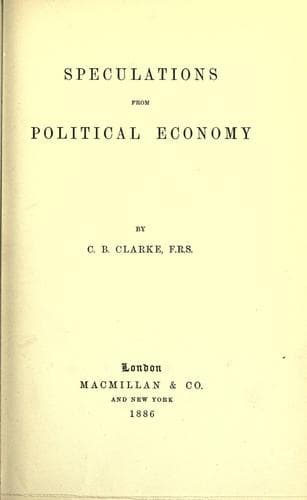
Speculations from Political EconomyClarke, Charles Baron
General
Speculations from Political Economy
Clarke, Charles Baron
Economics
The advocates of peasant-proprietors have thought cowkeeping hopeful
for small men. In my experience dairies of fifty or sixty cows have an
enormous advantage; they can have perfectly designed dairies; they have
enough cream to make butter daily throughout the year (which saves much
trouble, loss, and occasionally inferior butter); they can maintain
approximately a uniform supply. In short, they beat, undersell, and
displace the small cowkeepers wherever the large dairy is moderately
well managed.
The cottager or peasant-proprietor has, I believe, an advantage in
poultry of all kinds. When poultry are kept in very large numbers
they are more liable to disease, and the diseases are more
disastrous--sweeping off the whole large stock. Fowl and egg farming is
one of the most successful, perhaps the most successful point with the
French peasant-proprietors. To make birdfarming successful the proper
plan is to keep a moderate number of as many birds as possible--fowls,
"galeenies," ducks, geese, turkeys, large pigeons--and to go in for
eggs as well as fowls. I have not seen peasant-proprietors in
England attempting this, which seems to me one of the most hopeful of
experiments for them.
The second point urged by Mill, and still by some, is that
peasant-proprietors are better off than English labourers. With the
present price of agricultural labour in England this seems to be
very generally not the case; the French peasant-proprietors and the
agricultural lower classes in Germany are (with small exceptions) now
worse off than the English farm-labourer; they work very much harder
and they get less to eat. The economic truth doubtless is that the
hired labourer may or may not be better off than the peasant-proprietor,
according to circumstances; and circumstances in England just now are in
favour of the hired labourer.
Then as to independence, it may fairly be questioned whether a good
agricultural workman, now practically liberated from the Law of
Settlement, and who can command a fair wage anywhere, is not really more
independent than a French peasant absolutely tied to a three-acre plot
for life.
The real difference between the advocates of the nationalisation of
the land and the Conservatives is this. The Conservative says, "Leave
everything to its natural course, and let us have no Government
interference. If the peasant-proprietor really can maintain himself
while paying as high a rent as the ordinary farmer, we shall soon
have plenty of them." Or, the Conservative has no objection to
a philanthropist starting a few picked peasant-proprietors as an
experiment. But he objects to starting any gigantic new scheme of
working the land, except as a matter of business; he objects to
Government philanthropy, which means giving away other people's money.
Public-domain text, read in full here on John Shaqi.
Reviews
Reviews
No reviews yet
Be the first to share your thoughts on this work.
Join the Discussion
Join the discussion
Sign in to leave a comment or review.
Sign InorCreate an account