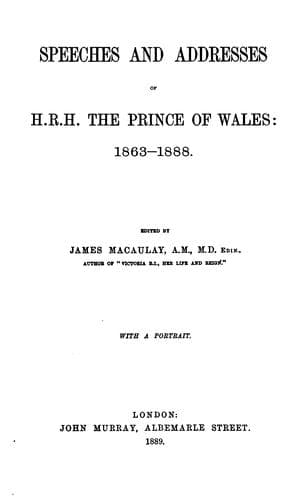
Speeches and Addresses of H. R. H. the Prince of Wales: 1863-1888Edward VII, King of Great Britain
History
Speeches and Addresses of H. R. H. the Prince of Wales: 1863-1888
Edward VII, King of Great Britain
Great Britain -- Politics and government -- 1837-1901
"O Father of mercies and God of all comfort, we thank Thee that Thou
hast heard the prayers of this nation in the day of our trial. We praise
and magnify Thy glorious name for that Thou hast raised Thy servant
Albert Edward Prince of Wales from the bed of sickness. Thou castest
down and Thou liftest up, and health and strength are Thy gifts. We pray
Thee to perfect the recovery of Thy servant, and to crown him day by day
with more abundant blessings both for body and soul; through Jesus
Christ our Lord. Amen."
When the Thanksgiving day was proclaimed, it was still doubtful whether
the Prince himself would be allowed by his medical attendants to risk
the winter journey for Osborne, along with the Queen. But his own desire
to be present nerved him for the effort, and he obtained the assent of
Sir James Paget, who had gone specially to give his opinion.
The danger had increased in the end of November and the first weeks of
December. The first hopeful announcement was made on December 17th, and
on January 3rd convalescence had decidedly begun. A public thanksgiving
service was proclaimed for the 21st of January. On February 22nd the
Letter of the Queen to the nation was published, and then followed the
National Thanksgiving Service in St. Paul's on the 27th.
With regard to the Royal procession, and the display inside the
Cathedral, the scene was far less imposing than on that famous day, the
23rd of April, 1789, when King George III. and Queen Charlotte went to
St. Paul's to return public thanks for His Majesty's restoration to
health. On that occasion there was more of heraldic pageantry, and more
of official display, than accords with modern usage. But everything was
done to make this assemblage as far as possible representative of all
classes in social and public life. Not fewer than 13,000 persons had
places allocated to them in the Cathedral. In the _Times_ of Wednesday,
February 28th, a full classified list of the ticket-holders will be
found. About 300 Mayors and Provosts from all parts of the kingdom had
places. There were 560 places for representatives of the Army and Navy.
The Peers and Commons had 885 tickets for each house. The Dean of St.
Paul's had nearly 1300 tickets at his disposal. The Corps Diplomatique,
"distinguished foreigners," London School Board, the Board of Works,
Learned Societies, Nonconformists, and numerous other bodies figure in
the catalogue. The wearers of uniform and official dress, besides the
gaudy civic corporations, gave variety to the scene. The Judges,
English, Scotch, and Irish, with robes and wigs, gave warm tone to the
Law corner. Special state chairs were occupied by the Lord Chancellor
and the Speaker, representing Parliament. The Press had 80 places, and
the "General Public" made up the number 12,480 tickets--those who took
part in the procession--the stewards, police, firemen, and the officials
bringing up the total to about 13,000.
Public-domain text, read in full here on John Shaqi.
Reviews
Reviews
No reviews yet
Be the first to share your thoughts on this work.
Elsewhere in the archive
Join the Discussion
Join the discussion
Sign in to leave a comment or review.
Sign InorCreate an account