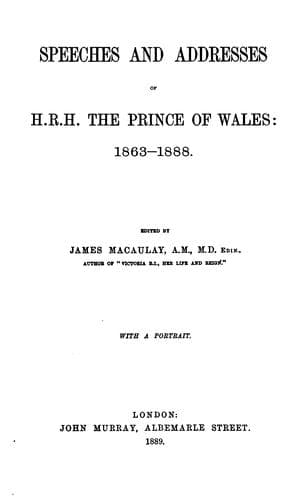
Speeches and Addresses of H. R. H. the Prince of Wales: 1863-1888Edward VII, King of Great Britain
History
Speeches and Addresses of H. R. H. the Prince of Wales: 1863-1888
Edward VII, King of Great Britain
Great Britain -- Politics and government -- 1837-1901
The crowds lining the streets, for about seven miles along which the
procession passed, were innumerable; and every window and coign of
vantage, with numerous scaffoldings along the line, appeared filled with
spectators. Not even when the Princess of Wales entered London was there
such a dense multitude seen, and it is only on rare occasions that one
can see "all London in the streets." In our time we can remember some
such occasions--the funeral of the Duke of Wellington, the reception of
the Princess of Wales, and the entrance of Garibaldi, being among them.
It was not in the Metropolis alone, that the rejoicing was universal.
Every city and town had its festivities, and its services of
thanksgiving in Church and Chapel. Addresses came, by hundreds, from all
quarters, and the announcement was made of holiday gatherings, of
crowded meetings, of illuminations, and every form of public rejoicing.
The telegraph flashed news of similar excitement throughout the whole of
the Empire; and religious services were held wherever Englishmen are
found on the Continent, in the Colonies, and in India. If ever a
rejoicing could be called national and imperial, it was this, on the
Thanksgiving Day for the recovery of the Prince of Wales.
The service commenced with the _Te Deum_, composed expressly for the
occasion by Dr. Goss. The music of the anthem, from the words of Psalm
118th, verses 14-21, and 28, was by the same composer. Among other
musical pieces was the choral hymn, "Gotha," by the Prince Consort. The
whole of the service, devotional and musical, was most impressive, and
the special prayers and thanksgivings were joined in by the vast
congregation with devoutest feeling. It was noted by one who was
present, with regard to the familiar "General Thanksgiving," that "the
sublimity of the service culminated, and reached its highest and
intensest expression, during the silent pause which followed the
inserted words: "Particularly to Albert Edward, Prince of Wales, who
desires now to offer up his praises and thanksgiving for Thy late
mercies vouchsafed to him."" The famous words which close the poem of
the Seasons: "Come then expressive silence muse His praise," could be
well understood in that perfect pause of a few moments, almost awful in
its intensity, in the service at St. Paul's Cathedral. When the anthem
had been sung, the Archbishop of Canterbury gave a short sermon or
address, from Romans xii. 5: "Every one members one of another." This
was followed by the special Thanksgiving Hymn, written by the Rev. J. S.
Stone, author of "The Church's one foundation," and "Sonnets of the
Sacred year." It was sung to the good and familiar tune _Aurelia_, by
Dr. S. Wesley. Then the Archbishop pronounced the benediction. When the
organ sounded the grand notes of the National Anthem, Her Majesty came
forward and bowed twice, and the Prince bowed also. The organ continued
to play variations of the anthem as the Royal procession moved down the
nave.
Public-domain text, read in full here on John Shaqi.
Reviews
Reviews
No reviews yet
Be the first to share your thoughts on this work.
Elsewhere in the archive
Join the Discussion
Join the discussion
Sign in to leave a comment or review.
Sign InorCreate an account