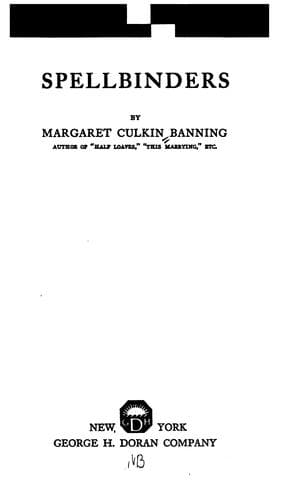
City and town life -- Fiction; Middle West -- Fiction; Spouses -- Fiction; Women -- Political activity -- Fiction
For the first time she understood what Margaret meant by the freedom of
women and why she was not content with the formal letting down of the
gates. She understood what some of the others meant when they talked of
the easy contemporary victories as obscuring the real things which women
needed.
The best of them did not talk the lingo of the “new day.” They knew that
any day was not new long enough to get used to its title. They talked
of adjustment of contemporary circumstances to an evolution as old as
that of civilization, as old as that of man--merged with male
development and yet distinct from it again. They avoided catch words and
the flattery which was sprinkled so thickly, avoided it not pedantically
but with humorous knowledge of its purpose.
They dined with Mrs. Thompson and three other women and held a kind of
informal court afterwards in one of the parlors of the hotel. Every
notable man who came into the hotel seemed to want a word with Mrs.
Thompson. She had a way with them that they all liked, a kind of keen
camaraderie, especially effective in a woman who, like Mrs. Thompson,
could never be accused of trying out any arts of sex attraction. They
liked her company and her brisk tongue and there was added interest in
finding such company in a woman. Helen met the Senators--the men whose
names the party conjured with and handled them as she handled most
people--skillfully.
It was a little after nine when Helen saw Gage at the end of the room.
She had been talking with a gray haired, affable Senator who was telling
her what a beneficent influence the women were to have on the Convention
and she was excited, amused and sparkling. She was wearing a dinner
dress of black lace that Gage had always liked and as she caught his
eyes on her that was the first thought which flashed through her mind.
It was followed by a quick appraisal of Gage himself. He was looking a
little untidy and showing clearly the signs of recent strain and worry.
He did not make his way to her at once. He stopped to talk casually to
some men whom he knew. Helen thought suddenly that Gage was not a big
man politically. He did not have nearly as much prestige as Mrs.
Thompson of course, not nearly as much strength as she herself might
have--. She saw Margaret introducing him to Mrs. Thompson. His manners
were bad. He had none of the easy pleasant way with which the other men
had come up to her. He must be making an extremely bad impression. It
humiliated her somewhat. They were still too close for her not to feel
that.
She joined the group where were Gage and Mrs. Thompson and Margaret.
“Have you had a good day, Gage? I called up the house and the children
are fine. Not a trace of their colds, Esther said.”
He nodded gravely. Their eyes met, denying any intimacies of exchange,
coldly, a little cruelly.
“I hear your wife is to make the prize seconding speech to-morrow, Mr.
Flandon,” said Harriet Thompson, bending towards him.
Public-domain text, read in full here on John Shaqi.
Reviews
Reviews
No reviews yet
Be the first to share your thoughts on this work.
Elsewhere in the archive
Join the Discussion
Join the discussion
Sign in to leave a comment or review.
Sign InorCreate an account