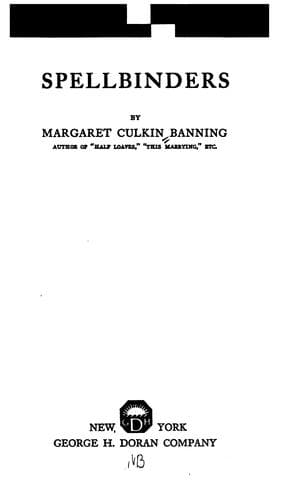
City and town life -- Fiction; Middle West -- Fiction; Spouses -- Fiction; Women -- Political activity -- Fiction
“You couldn’t get absorbed in his enthusiasm because you’ve got one of
your own, haven’t you?”
“I have yours.”
Mrs. Thompson patted her affectionately on the arm. Her contacts were
all warm and intimate. With men and women alike, she seemed to get
inside their minds and look out on the world as they saw it.
“You’re a dear girl,” she told her, “but you must remember that humanity
is a bigger thing even than feminism, Margaret. Be a little more tender
towards the poor men. After all, they can’t all be transported.”
All afternoon the crowds swelled. In the evening the great hotel
dining-rooms were filled with people who represented almost
everything--power, wealth, notoriety, ambition. Headquarters were
established. Newspaper men idled to and fro, joking, prophesying,
gossiping. Underneath the fatuousness of much of the pretense that this
was a great popular meeting, most of the people knew that the rules were
already laid down and things would take their course--must take their
course. And yet there was a certain amount of fair speculation as to
whether in some way the great leaders might not be outwitted after
all--whether some new element might not show sudden strength, whether
the unorganized, half formulated hopes and ideals of millions of
ordinary people might this time put themselves across and lead instead
of follow. The Convention, like the world, was attuned to surprises,
revolts, inexplicable overturnings.
Helen was more than excited. A little less than two days ago she had
felt that she could not go on with this--that the personal agony had to
be fought out first. To her amazement she found that Margaret had been
right. Helen had always agreed with her that women were really not
dependent on emotion but that had been because Margaret’s contention
seemed reasonable and to take the other side hardly worthy. An inner
feeling had persisted that after all Margaret was unmarried and
didn’t--couldn’t know the strength of the emotional pull. But now she
found herself breaking through personal emotional wreckage to impersonal
interest--or if not impersonal interest at least interest in which sex
played no part. She had at first kept up the signs of control because
she must. Now she no longer needed the signs. She thought of Gage almost
dispassionately. Now and then the tragedy of the ruined feeling between
them shook her violently. But she could see their situation spread out
before her. She could see it in relation to the children, to other work.
She could see where things must be stopped in that they did not improve.
And most of the time she hardly thought of Gage at all. She was
responding to all the excitement and interest and admiration around her.
She felt part of a great organization about to act in ways which would
affect the world. The great sensibility of her woman’s imagination,
undulled by much experience in the direction of things beyond her
contact, was played upon by a vision of great power which she might help
direct.
Public-domain text, read in full here on John Shaqi.
Reviews
Reviews
No reviews yet
Be the first to share your thoughts on this work.
Elsewhere in the archive
Join the Discussion
Join the discussion
Sign in to leave a comment or review.
Sign InorCreate an account