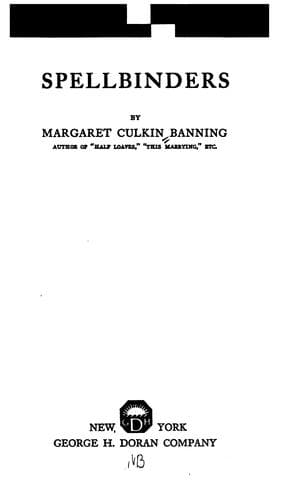
City and town life -- Fiction; Middle West -- Fiction; Spouses -- Fiction; Women -- Political activity -- Fiction
It was Thursday evening when the “Town Reporter” bristled with ugly
headlines on the streets of St. Pierre. Walter’s body lay in the
undertaking “parlors” those ineffective substitutes for homes for those
who die homeless, in the brief period between their last hours among
human kind and the grave. No place except a home can indeed truly
shelter the dead. Walter lay inscrutably lonely, in the public parlor,
mysterious in the death which was a refusal to go on with life, a
relinquishment so brave and so cowardly that it always shocks observers
into awe. As he lay there, a raucous voiced newsboy outside the window
ran down toward the main throughfare, a bunch of “Town Reporters” under
his arm, shouting, “All the noos about the sooicide”--and in half an
hour his papers were gone, some bought openly, some bought hurriedly and
shamefacedly. Hundreds of people now knew the reason Elihu Robinson gave
for the death of Walter Carpenter, his version of the struggle in the
stilled brain of the man he had not known except by sight and hundreds
of people as intimate with the tragedy as he, wagged their heads and
said wisely that this “was about the truth of it,” with other and sundry
comments on the corruption of the age and particularly of the rich.
The Flandons read it with mixed disgust and anger. They knew it was the
kind of stain that only time could scrub away. It did not matter much to
Walter now that he was slandered. His suicide was a defiance of slander.
They were sorry for Margaret but not too much bothered by her reception
of such scandal if it came to her. It was only local scandal.
“The worst of it,” said Helen to Gage, “is tying Gregory Macmillan up
that way just as they were about to announce his marriage. I telephoned
Freda’s father this afternoon for I was going to tell him you had had a
business letter from her and knew where she was. It seemed wise. But
anyway he had just heard from her too. He was so happy, poor fellow. Now
to have this nasty scandal about his son-in-law will be another blow. I
shall go to see him and tell him that it’s an utter lie. I know from
what Margaret told me that there never was a thing between her and
Macmillan.”
* * * * *
Mr. Thorstad had already taken the matter up with Elihu Robinson. He had
called him what he was and his white faced indignation was something the
editor preferred to submit to without resistance. But he was not without
trumps as usual.
“But who is your authority for saying that Macmillan was implicated with
this lady?” asked Mr. Thorstad, angrily.
He had not told that Macmillan was his son-in-law and the editor
wondered at his defense of Macmillan.
“My dear fellow,” he said with that touch of apologetic and righteous
concern with which he always met such attacks. “My dear fellow, your
wife told me that.”
CHAPTER XXII
THE MOURNERS
Public-domain text, read in full here on John Shaqi.
Reviews
Reviews
No reviews yet
Be the first to share your thoughts on this work.
Elsewhere in the archive
Join the Discussion
Join the discussion
Sign in to leave a comment or review.
Sign InorCreate an account