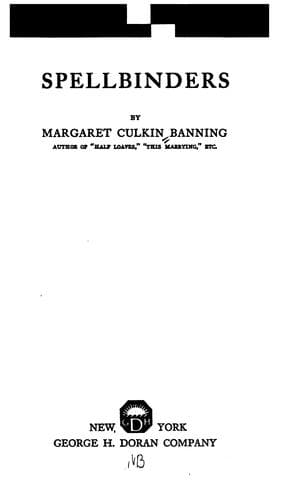
City and town life -- Fiction; Middle West -- Fiction; Spouses -- Fiction; Women -- Political activity -- Fiction
Margaret came, calm and yet clearly distressed beyond measure. It was
pathetic to see her control, to see that she could not even break
through it to the relief of abandonment. She was very white during the
day of the funeral and the ones succeeding it and her eyes met other
eyes somewhat reluctantly. She came on Friday morning and Helen had not
been able to persuade her to stay with them. She had gone to a hotel and
from there, quite simply to the parlors of the undertakers.
“Don’t wait for me, Helen--and I’d sooner be alone. I’ll be here a long
while, probably.”
Perhaps after all Walter and Margaret found relief in each other when
the grim parlor door was shut. At least at the funeral Margaret sat very
quietly, though the well-bred curious eyes of the little group of people
strayed unceasingly toward her. She went through it as she went through
the following days. It was soon known, before the will was probated,
that she was Walter’s legatee. There was a great deal of business to be
done. Walter had decided no doubt that the brief embarrassment of
inheriting his fortune was better than the recurrent fear of cramping
poverty which had always pursued her and of which she had told him. She
saw the lawyers and his business associates and discussed with them the
best way of disposing of Walter’s interests, and word of her coldness
spread around rather quickly and was considered to justify Mr.
Robinson’s deductions.
Gage saw her at the funeral. He had not looked for her--had not felt
ready to see her. But in the semicircle of chairs facing the gray satin
coffin, he was so placed that his eyes met hers unexpectedly. When they
did, hostility glinted in his. “You got him,” they seemed to say--and
hers looked back steady, unrepentant, even though her mouth was drawn
with pain and sorrow.
It had hit Gage as it had Helen. The lightning had been drawn from him.
Walter’s death had roused in him an instinct of resistance which had
been dormant. He had no certain idea of what had passed between Walter
and Margaret but he knew what Carpenter’s point of view had been--how
far he had gone, how willing he had been to yield every concession to a
woman--to Margaret--in the belief that it would then be possible to
build love on a basis of comradeship. Walter had found failure, just how
or why no one knew except perhaps Margaret herself. Gage’s mind stumbled
along nervously, trying to analyze his and Walter’s failure. He
remembered how they had talked together about women, how Walter had said
he would be “willing to trust to their terms.” For some reason he lay
dead of their terms. And he himself--he had looked at himself in the
glass an hour ago with a kind of horror as if he saw himself for the
first time in weeks. There was a softening of his features it seemed to
him, a look of dissipation, of untrimmed thought, brooding. The memory
of his face haunted him. That was what came of being unwilling to trust
to the terms of women. Either way--
Public-domain text, read in full here on John Shaqi.
Reviews
Reviews
No reviews yet
Be the first to share your thoughts on this work.
Elsewhere in the archive
Join the Discussion
Join the discussion
Sign in to leave a comment or review.
Sign InorCreate an account