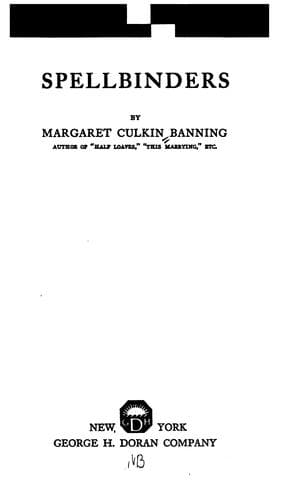
City and town life -- Fiction; Middle West -- Fiction; Spouses -- Fiction; Women -- Political activity -- Fiction
So it was all right until Barbara came in. A little party gathered in
the meantime--the Gage Flandons, and Margaret Duffield with Walter
Carpenter. Margaret was beginning to be asked as a dinner companion for
Walter fairly often now. And as a concession to the young people Mrs.
Brownley had asked three young men, Ted Smillie and the Bates boys, who
traveled in pairs, Allie always said. They were all there when Barbara
came in. Obviously she had some one, either the unknown guest or her
friend Ted, in mind when she dressed, for she was perfectly done.
Smoothly marcelled hair, black lace dress carrying out the latest
vagaries in fashion, black slippers with jeweled buckles. As she gave
her hand to Freda with the smile which held a faint hint of
condescension, Freda bent her knuckles to hide the nail she had torn
yesterday closing the trunk. She felt over dressed, obvious, a splash of
ugly color. Ted had been talking to her but by a simple assumption that
Freda could have nothing of interest to say, Barbara took up the thread
of talk with him, speaking of incidents, people that were unknown to
Freda. The Bates boys were talking to Allie. Freda stood alone for a
moment--an interminable awkward moment, in which no one seemed to notice
her. Then Gage Flandon crossed to her side and she gave him a smile
which made him her friend at once, a smile of utter gratitude without a
trace of pose.
“How nice of you,” she said, simply, “to come to talk to me. I feel so
strange.”
“My wife says you’ve never met any of us before. No wonder.”
“It isn’t just that. I’m a little afraid I’m here without much reason.
Mother brought me but I’m not a political woman and I’m not”--with a
rueful little glance at Barbara--“a society girl at all. I’m afraid I’ll
be in everybody’s way.”
She said it without any coquetry and it came out clearly so--as the
plain little worry it was. Gage, who had found himself a little touched
by the obvious situation of the girl felt further attracted by her
frankness. She seemed an unspoiled, handsome person. That was what Helen
had told him, but he had grown so used to sophistication and measured
innocence that he had not expected anything from the daughter of this
little political speaker. He had come to size up Mrs. Thorstad, for her
name had been presented as a possibility in a discussion with some of
his own friends as they went over the matter of recognizing women in the
political field. As Mrs. Thorstad gave her hand to him he had seen what
he came to see. She had brains. She had the politician’s smile. She
could be used--and doubtless managed as far as was necessary. But the
daughter was different. He liked that dress she was wearing. It showed
her slimness, suppleness, but it didn’t make her indecent like that lace
thing on Bob Brownley.
Public-domain text, read in full here on John Shaqi.
Reviews
Reviews
No reviews yet
Be the first to share your thoughts on this work.
Join the Discussion
Join the discussion
Sign in to leave a comment or review.
Sign InorCreate an account