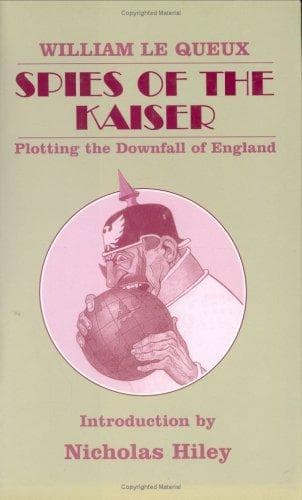
Spies of the Kaiser: Plotting the Downfall of EnglandLe Queux, William
History
Spies of the Kaiser: Plotting the Downfall of England
Le Queux, William
Espionage, German -- Fiction; Great Britain -- History -- Invasions -- Fiction; Intelligence service -- Fiction; Spy stories
"That cannot be denied," was his reply. "This neighbourhood opens up a
wide field of investigation to the inquisitive gentry from the
Fatherland. Knowledge of the secrets of the defences of the Firth of
Forth would be of the utmost advantage to Germany in the event of an
invasion. The local submarine defences and corps of submarine miners
have been done away with, yet the entrance of the estuary is commanded
by strong batteries upon the island of Inchkeith, opposite Leith; the
Forth Bridge is defended by masked batteries at Dalmeny at the one end
and at Carlingnose at the other, while upon Inchgarvie, the rock beneath
the centre of the bridge, is a powerful battery of six-inch guns. The
true strength of these defences, and the existence of others, are, of
course, kept an absolute secret, but Germany is equally anxious to learn
them, as she is to know exactly what our plans are regarding this new
naval base and its fortifications."
"But if the new base were established, might not the Forth Bridge be
blown into the water by the enemy, and our fleet bottled up by the
wreckage?" I ventured to remark.
"That's just the point, Jack," my friend said; "whether the Rosyth works
are carried out or not, the Germans would, without doubt, use their
best endeavours to blow up the bridge; first in order to cut direct
communication between north and south, and secondly, to prevent British
ships using St. Margaret's Hope as a haven of refuge."
"And even in face of the document discovered upon the auctioneer's
clerk, the Government deny the activity of spies!"
"Yes," said Ray in a hard voice. "A week ago I was up here, and examined
the safe in the offices we've passed. I was only laughed at for my
pains. I must admit, of course, that no document has ever been missing,
and that the safe has not been tampered with in any way."
"A complete mystery."
"One which, my dear Jack, we must solve," he said, as we retraced our
steps back to North Queensferry station, where we luckily caught a train
back to Edinburgh.
Next morning we travelled again to Dalmeny, and in the grey mist hired a
boat at the slippery landing-stage opposite the Hawes Inn. Refusing the
assistance of the boatman, Ray took off his coat and commenced to row to
the opposite shore. His action surprised me, as we could easily have
gone over by the steam ferry. It was high tide, and by degrees as we got
into mid-stream he allowed the boat to drift towards one of the sets of
four circular caissons in which the foundations of the gigantic bridge,
with its bewildering masses of ironwork, were set.
Against one of them the boat drifted, and he placed his hand upon the
masonry to prevent a collision. As he did so, his keen eyes discerned
something which caused him to pull back and examine it more closely.
As he did so, a train rumbled high above us.
Public-domain text, read in full here on John Shaqi.
Reviews
Reviews
No reviews yet
Be the first to share your thoughts on this work.
Join the Discussion
Join the discussion
Sign in to leave a comment or review.
Sign InorCreate an account