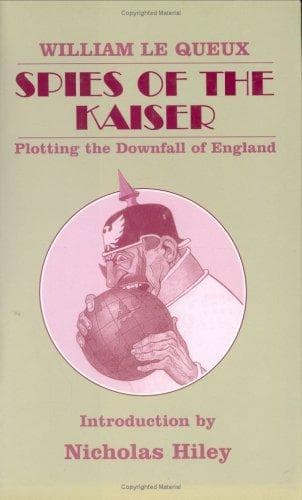
Spies of the Kaiser: Plotting the Downfall of EnglandLe Queux, William
History
Spies of the Kaiser: Plotting the Downfall of England
Le Queux, William
Espionage, German -- Fiction; Great Britain -- History -- Invasions -- Fiction; Intelligence service -- Fiction; Spy stories
Through five consecutive nights, unknown to the caretaker, who slept so
peacefully in his bungalow, we, however, kept a vigilant watch upon the
place. But in vain. Whatever information our friends the Germans wanted
they seemed to have already obtained.
Ray Raymond, however, continued to display that quiet, methodical
patience born of enthusiasm.
"I'm confident that something is afoot, and that there are spies in the
neighbourhood," he would say.
Nearly a fortnight we spent, sometimes in Edinburgh, and at others
idling about North Queensferry in the guise of English tourists, for the
Forth Bridge is still an attraction to the sightseer.
Upon the German waiter at the Golf Club Ray was keeping a watchful eye.
He had discovered his name to be Heinrich Klauber, and that before his
engagement there he had been a waiter in the basement café of the Hôtel
de l'Europe, in Leicester Square, London.
His movements were in no way suspicious. He lived at a small cottage
nearly opposite the post office at North Queensferry with a widow named
Macdonald, and he had fallen in love with a rather pretty dark-eyed girl
named Elsie Robinson, who lived with her father in the grey High Street
of Inverkeithing. As far as my observations went--and it often fell to
my lot to watch his movements while Ray was absent--the German was
hardworking, thrifty, and a pattern of all the virtues.
One evening, however, a curious incident occurred.
Ray had run up to London, leaving me to watch the German's movements.
Klauber had returned to Mrs. Macdonald's about eight, but not until
nearly eleven did he come forth again, and then instead of taking his
usual road to Inverkeithing to meet the girl Robinson, he ascended the
hill and struck across the golf-course until he had gained its highest
point, which overlooked the waters of the Forth towards the sea.
So suddenly did he halt that I was compelled to throw myself into a
bunker some distance away to escape detection. Then, as I watched, I saw
him take from his pocket and light a small acetylene lamp, apparently a
bicycle-lamp, with a green glass. He then placed it in such a position
on the grass that it could be seen from far across the waters, and
lighting a cigarette, he waited.
The light on the Oxcars was flashing white and red, while from distant
Inchkeith streamed a white brilliance at regular intervals. But the
light of Heinrich Klauber was certainly a signal. To whom?
He remained there about half an hour, but whether he received any
answering signal I know not.
Next night and the next I went to the same spot, but he failed to put in
an appearance. Then, in order to report to Ray, I joined the morning
train from Perth to London.
Public-domain text, read in full here on John Shaqi.
Reviews
Reviews
No reviews yet
Be the first to share your thoughts on this work.
Join the Discussion
Join the discussion
Sign in to leave a comment or review.
Sign InorCreate an account