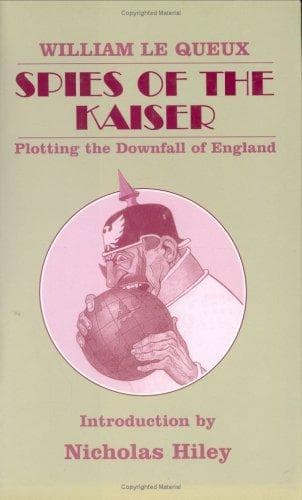
Spies of the Kaiser: Plotting the Downfall of EnglandLe Queux, William
History
Spies of the Kaiser: Plotting the Downfall of England
Le Queux, William
Espionage, German -- Fiction; Great Britain -- History -- Invasions -- Fiction; Intelligence service -- Fiction; Spy stories
Just before eleven that same night I strolled past the house of Hermann
Hartmann, in Pont Street, vaguely wondering what I could do to prevent a
theft which must, I knew, shortly be committed. In all probability the
ingenious Hartmann already had a secret agent in Joynson's works, but
even if he had, he would certainly not be able to discover the secret.
I had quite satisfied myself upon that point.
No, the peril lay in the Professor himself--the strange old pig-headed
patriot.
Scarcely had I passed Hartmann's house, the exterior of which I knew so
well, when I heard the front door close and saw a man coming down the
steps. As he walked in my direction I halted beneath a lamp to light a
cigarette, and by so doing I obtained a glimpse of his face as he
passed.
He was a young, good-looking, smartly dressed man, with dark eyes and
hair and a rather sallow complexion. I put him down to be an Italian,
but I had never set eyes upon him before. No doubt he was one of
Hartmann's travelling agents--a man who went up and down England
visiting the fixed spies of Germany, or "letter-boxes," as they are
known in the bureau of secret police in Berlin--collecting their reports
and making payments for information or services rendered.
Knowing so much of the ways of the German secret agent, curiosity
prompted me to follow him. He strolled as far as the corner of Sloane
Street and Knightsbridge, and then boarded a motor-bus as far as
Piccadilly Circus. Thence he walked to the German beer-hall, the
Gambrinus, just off Coventry Street, where he joined a tall, thin,
grey-moustached man, an Italian like himself, who was seated awaiting
him. I idled across to a table close by, called for beer, and sat
smoking a cigarette and straining my ears to catch their conversation,
which was in Italian, a language I know fairly well.
I discovered the following facts. The thin-faced man was called
Giovanni, while the elegant young fellow was Uberto, and they were
discussing the arrival of somebody. Giovanni seemed dubious about
something, while the man who had left Hartmann's seemed enthusiastic.
After a quarter of an hour Uberto glanced at his watch, made some remark
to his companion, and they rose and went out together, driving in a
taxicab westward, I following in another, which I fortunately found
just in time. Through Kensington we went, over Hammersmith Bridge,
through Barnes, and across the Common.
Then I realised we were going to Richmond.
The chase grew exciting. Before me I could see the red back-lamp of the
taxi as it sped forward, and half an hour later we were crossing
Richmond Bridge, where, a short distance along the road to Twickenham,
they suddenly swung round to the left into St. Margaret's and pulled up
before a good-sized detached house which stood back in its own grounds,
in which were several big trees. The thoroughfare was, I noted, called
Brunswick road.
Public-domain text, read in full here on John Shaqi.
Reviews
Reviews
No reviews yet
Be the first to share your thoughts on this work.
Elsewhere in the archive
Join the Discussion
Join the discussion
Sign in to leave a comment or review.
Sign InorCreate an account