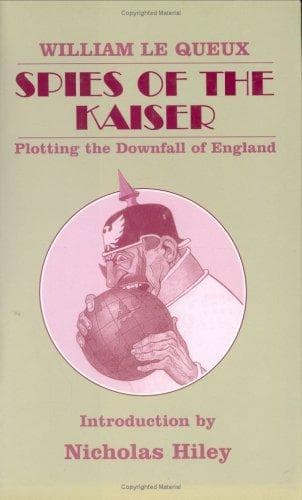
Spies of the Kaiser: Plotting the Downfall of EnglandLe Queux, William
History
Spies of the Kaiser: Plotting the Downfall of England
Le Queux, William
Espionage, German -- Fiction; Great Britain -- History -- Invasions -- Fiction; Intelligence service -- Fiction; Spy stories
My taxi-driver proved himself no fool. I had told him to follow;
therefore, unable to pull up sharply, he swept past, and did not stop
until we were round the bend in the quiet suburban road and thus out of
sight.
I ordered him to remain, and, alighting, strolled back past the house in
question. About its dark exterior was a distinct air of mystery. The
pair had entered, and the taxi was awaiting them. The house was an
old-fashioned one, solid and substantial in character, and apparently
the residence of some prosperous City man; yet I wondered why its owner
should have visitors at that hour. Surely great urgency had compelled
the pair to come all the way from Piccadilly Circus to consult him.
But a surprise was in store for me.
After lurking about in the shadows with that expert evasiveness which I
had now acquired, I presently saw the pair make their exit, but, to my
surprise, they were accompanied out to the kerb by a woman--apparently
a lady in black evening dress, the bodice of which was cut low.
About her shoulders she had wrapped a pale blue shawl, and as the young
Uberto entered the taxi I heard her exclaim in Italian:
"_Addio!_ To-morrow at one then, at Prince's."
As she moved I saw her countenance by the light of the cab lamp, a
handsome, well-cut face, typical of a woman of Piedmont, for she had
spoken in a dialect unmistakably that of Turin. The Turinese are more
French than Italian, and are as different in both temperament and
language from those of the south as the people of the Ardennes differ
from those of Paris.
Both men shook hands with her warmly, bade her "_Addio_," and entering
the taxi, drove away back to London, while I stood still watching.
And as I gazed I saw as she walked back to the house, in the doorway,
silhouetted against the light, an old man coming forward towards her.
"_Dio!_" she cried, half in alarm at seeing him. Then in Italian, she
added, "Why do you risk being seen, you imbecile? Why didn't you keep
where you were?"
Then the door closed, and seeking my taxi I also returned to Bloomsbury.
But that incident had aroused a good deal of doubt and suspicion within
me. Who was that handsome young Italian woman whom the spies had visited
at that late hour? And, above all, who was that man with whom she had
been annoyed for showing himself?
Next day proved conclusively that some crooked business was in progress,
for while I sat alone eating my lunch in a corner of the big room at
Prince's Restaurant in Piccadilly, I was amazed to see the well-dressed
young Italian--the man whom I had seen emerge from Hartmann's in Pont
Street, enter with no other person than Nella Emden.
Surely the spies had already made considerable progress! My indignation
was such that I could have walked over to the table where the pair had
seated themselves, and denounced that elegant Italian as a spy of the
Kaiser. But I foresaw that by patience I might yet discover more that
would be of interest.
Public-domain text, read in full here on John Shaqi.
Reviews
Reviews
No reviews yet
Be the first to share your thoughts on this work.
Elsewhere in the archive
Join the Discussion
Join the discussion
Sign in to leave a comment or review.
Sign InorCreate an account