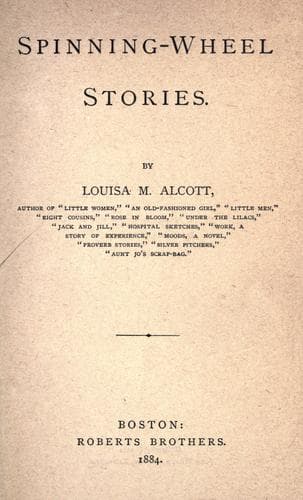
Children -- Conduct of life -- Juvenile fiction; Children's stories; Conduct of life -- Juvenile fiction
"That hurt him; but he was always gentle to saucy Betsey, and taking out
his knife, he cut those letters under mine, saying, with a look I never
could forget:--
"'That will remind you of me if you are likely to forget. Good-by; I'm
going right away, and may never come back.'
"He kissed me, and was off before I could say a word, and then I cried
till my flax was wet and my thread tangled, and my heart 'most broken.
Deary me, how well I remember that heavy day!"
Grandma smiled, but something shone in her old eyes very like a tear,
and sentimental Lotty felt deeply interested at this point.
"Where does the fighting come in?" asked Geoff, who was of a military
turn, as became the descendant of a soldier.
"I didn't know or care much about the War of 1812, except as far as the
safety of one man was concerned. Joe got on without any harm till the
battle of New Orleans, when he was nearly killed behind the cotton-bale
breastworks General Jackson built."
"Yes, I know all about it. Jackson fought against twelve thousand, and
lost only seven men. That was the last battle of the war, January 8,
1815. Three cheers for grandpa!" shouted Geoff, waving a tidy, as no hat
was at hand.
The others echoed the hurrah, and grandma beamed with pride as she went
on: "We couldn't get news from the army very often in those troublous
times, and Joe was gone two years before the war ended. After the great
battle we had no news for a long spell, and we feared he was one of the
seven men killed. Those were dreadful days for all of us. My honored
mother was a pious soul, and so was Mrs. Shirley; and they kept up their
hearts with hope and prayer; but I, poor thing, was young and weak, and
I cried myself half blind, remembering how naughty I had been. I would
spin no more, but set the wheel away, saying I should have no need of
wedding gear, as I should never marry; and I wore black ribbon on my
caps, and one of Joe's buttons strung about my neck, mourning dismally
for my lost dear.
"So the winter ended, and the summer went, and no news came of Joe. All
said he was dead, and we had prayers at church, and talked of setting up
a stone in the grave-yard, and I thought my life was done; for I pined
sadly, and felt as if I could never laugh again. But I did; for the Lord
was very good to us, and out of danger and captivity delivered that dear
boy."
Grandma spoke solemnly, and folded her hands in thanksgiving as she
looked up at the picture of the handsome officer hanging on the wall
before her. The elder children could just remember grandpa as a very old
and feeble man, and it struck them as funny to speak of him as a "dear
boy;" but they never smiled, and dutifully lifted their eyes to the
queue and the high-collared coat, wondering if Joe was as rosy in real
life as in the portrait.
"Well, that's the sentimental part; now comes the merry part, and that
will suit the boys," said the old lady, briskly, as she spun away,--and
went on in a lively tone:--
Public-domain text, read in full here on John Shaqi.
Reviews
Reviews
No reviews yet
Be the first to share your thoughts on this work.
Join the Discussion
Join the discussion
Sign in to leave a comment or review.
Sign InorCreate an account