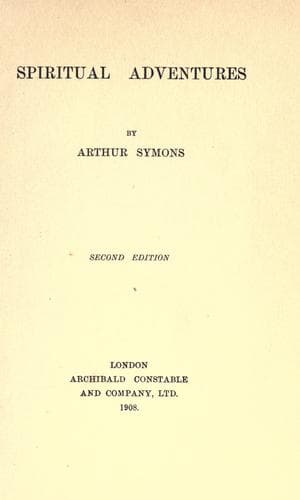
Great Britain -- Social life and customs -- 19th century -- Fiction; Short stories
At my last school there was one master, a young man, who wrote for a
provincial newspaper, of which he afterwards became the editor, with
whom I made friends. He had read a great deal, and he knew a few
literary people; he was equally fond of literature and of music. Some
school composition of mine had interested him in me, and he began to
lend me books, and to encourage me in trying to express myself in
writing. I had already run through Scott and Byron, with a very little
Shelley, and had come to Browning, whom he detested. When I was laid up
with scarlatina he sent me over a packet of books to read; one of them
was Swinburne's 'Poems and Ballads,' which seemed to give voice to all
the fever that I felt just then in my blood. I read 'Wuthering Heights'
at the same time and Rabelais a little time afterwards. I read all the
bound volumes of the 'Cornhill Magazine' from the beginning right
through, stories, essays, and poems, and I remember my delight in 'Harry
Richmond,' at a time when I had never heard the name of George Meredith.
I read essays signed 'R. L. S.', from which I got my first taste of a
sort of gipsy element in literature which was to become a passion when,
later on, 'Lavengro' fell into my hands. The reading of 'Lavengro' did
many things for me. It absorbed me from the first page, with a curiously
personal appeal, as of some one akin to me, and when I came to the place
where Lavengro learns Welsh in a fortnight, I laid down the book with a
feeling of fierce emulation. I had often thought of learning Italian: I
immediately bought an Italian Bible, and a grammar; I worked all day
long, not taking up 'Lavengro' again, until, at the end of the fortnight
which I had given myself, I could read Italian. Then I finished
'Lavengro.'
'Lavengro' took my thoughts into the open air, and gave me my first
conscious desire to wander. I learned a little Romany, and was always on
the lookout for gipsies. I realised that there were other people in the
world besides the conventional people I knew, who wore prim and shabby
clothes, and went to church twice on Sundays, and worked at business and
professions, and sat down to the meal of tea at five o'clock in the
afternoon. And I realised that there was another escape from these
people besides a solitary flight in books; that if a book could be so
like a man, there were men and women, after all, who had the interest of
a book as well as the warm advantage of being alive. Humanity began to
exist for me.
But with this discovery of a possible interest in real people, there
came a deeper loathing of the people by whom I was surrounded. I had
for the most part been able to ignore them; now I wanted to get away, so
that I could live my own life, and choose my own companions. My vague
notions of sex became precise, became a torture.
Public-domain text, read in full here on John Shaqi.
Reviews
Reviews
No reviews yet
Be the first to share your thoughts on this work.
Join the Discussion
Join the discussion
Sign in to leave a comment or review.
Sign InorCreate an account