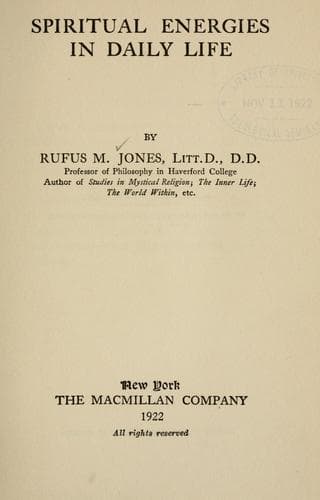
Spiritual Energies in Daily LifeJones, Rufus M. (Rufus Matthew)
Religion
Spiritual Energies in Daily Life
Jones, Rufus M. (Rufus Matthew)
Spiritual life
The profound significance of the words is often missed because the text
is so easily turned into a phrase that is supposed just of itself to work
a kind of magic spell, and secondly because the meaning of “faith” is so
frequently misinterpreted. When we go back to the original experience out
of which the famous text was born we can get fresh light upon the heart
of its meaning. The little book begins with a searching analysis of the
conditions of the time. With an almost unparalleled boldness the prophet
challenges God to explain why the times are so badly out of joint, why
the social order is so topsy-turvy, and why injustice is allowed to run a
long course unchecked. God seems unconcerned with affairs—the moral pilot
appears not to be steering things.
Then comes a moment of mental relief. The prophet hits upon the
conclusion, arrived at by other prophets also, that God is about to use
the Chaldeans as a divine instrument to chastise the wicked element in
the nation, to right the wrongs of the disordered world, and to execute
judgment. But as he begins to reflect he becomes more perplexed than
ever. How can God, who is good, use such a terrible instrument for moral
purposes? This people, which is assumed to be an instrument of moral
judgment in a disordered world, is itself unspeakably perverse. It is
fierce and wolfish. Its only god is might. It cares only for success. It
catches men, like fish, in its great dragnet, and “then he sacrificeth
unto his net and burneth incense unto his drag.” How can such a pitiless
and insolent people, dominated by pride and love of conquest, be used to
work out the ends of righteousness and to act for God who is too pure
even to look upon that which is evil and wrong? Here the prophet finds
himself suddenly up against the ancient problem of the moral government
of the universe and the deep mystery of evil in it. He cannot untangle
the snarled threads of his skein. No solution of the mystery lies at
hand. He decides to climb up into his “watch-tower” and wait for an
answer from God. If it does not come at once, he proposes to stay until
it does come—“if it tarry, wait for it; it will surely come.” At length
the vision comes, so clear that a man running can read it. It is just
this famous discovery of the great text that a man cannot hope to get the
world-difficulties all straightened out to suit him, he cannot in some
easy superficial way justify the ways of God in the course of history;
but, at least, he can live unswervingly and victoriously by his own
soul’s insight, the insight of faith that God can be trusted to do the
right thing for the universe which he is steering. It is beautifully
expressed in a well-known stanza of Whittier’s:
“I know not where His islands lift
Their fronded palms in air;
I only know I cannot drift
Beyond His love and care.”
Public-domain text, read in full here on John Shaqi.
Reviews
Reviews
No reviews yet
Be the first to share your thoughts on this work.
Join the Discussion
Join the discussion
Sign in to leave a comment or review.
Sign InorCreate an account