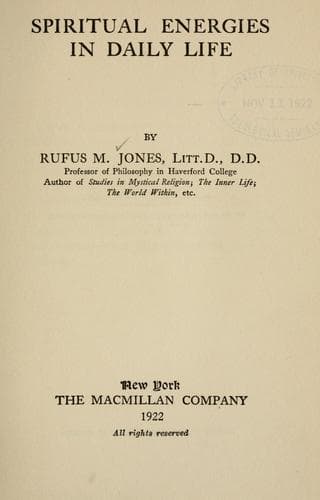
Spiritual Energies in Daily LifeJones, Rufus M. (Rufus Matthew)
Religion
Spiritual Energies in Daily Life
Jones, Rufus M. (Rufus Matthew)
Spiritual life
It is true, no doubt, as Shylock said, that we all have “eyes, hands,
organs, dimensions, senses, affections, passions,” are “subject to
diseases,” and “warmed and cooled by summer and winter.” “If you prick
us we bleed, if you tickle us we laugh, if you poison us we die,” and so
on. We do surely have wants and needs. We must consider values. We must
have food and clothes and houses. We must have some fair share of the
earth and its privileges. But that is only the basement and foundation
of real living, and we want a democracy that is supremely concerned with
the development of personality and with the spiritual organization of
society. We shall not make our estimates of persons on a basis of their
uses, or on the ground of their behavior as animal beings; we shall
live and work, if we are Christ’s disciples, in the faith that man is
essentially a spiritual being, in a world which is essentially spiritual,
and that we are committed to the task of awakening a like faith in others
and of helping realize an organic solidarity of persons who practice
this faith. Our rule of life would be something like the following: to
act everywhere and always as though we knew that we are members of a
spiritual community, each one possessed of infinite worth, of irreducible
uniqueness, and indispensable to the spiritual unity of the whole—a
community that is being continually enlarged by the faith and action of
those who now compose it, and so in some measure being formed by our
human effort to achieve a divine ideal.
The most important service we can render our fellow men is to awaken
in them a real faith in their own spiritual nature and in their own
potential energies, and to set them to the task of building the ideal
democracy in which personality is treated as sacred and held safe from
violation, infringement, or exploitation, and, more than that, in which
we altogether respect the worth and the divine hopes inherent in our
being as men.
IV
THE ESSENTIAL TRUTH OF CHRISTIANITY
There are few questions more difficult to answer than the question, What
is Christianity? Every attempt to answer it reveals the peculiar focus of
interest in the mind of the writer, but it leaves the main question still
asking for a new answer.
“Always it asketh, asketh,” and each answer, to say the least, is
inadequate. Harnack, Loisy, and Tolstoy have given three characteristic
answers to the great question. Their books are touched with genius and
will long continue to be read, but, like the other books, they, too,
reveal the writers rather than solve the central problem.
Public-domain text, read in full here on John Shaqi.
Reviews
Reviews
No reviews yet
Be the first to share your thoughts on this work.
Elsewhere in the archive
Join the Discussion
Join the discussion
Sign in to leave a comment or review.
Sign InorCreate an account