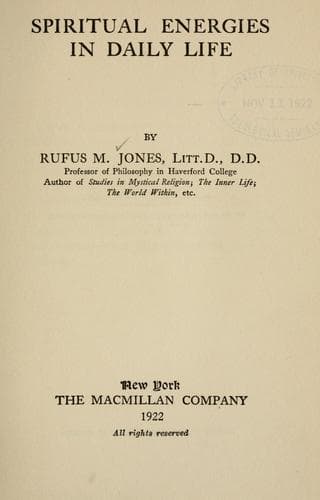
Spiritual Energies in Daily LifeJones, Rufus M. (Rufus Matthew)
Religion
Spiritual Energies in Daily Life
Jones, Rufus M. (Rufus Matthew)
Spiritual life
Anaxagoras said twenty-five hundred years ago that men are always
cutting the world in two with a hatchet. William James, in one of his
living phrases, says with the same import that everybody dichotomizes
the cosmos. It is so. We all incline to bisect life into alternative
possibilities. We split realities into opposing halves. We show a kind
of fascination for an “either-or” selection. We are prone to use the
principle of parsimony, and to be content with one side of a dilemma.
History presents a multitude of dualistic pairs from which one was
supposed to make his individual selection. There was the choice between
this world and the next world; the here and the yonder; the flesh and the
spirit; faith and reason; the sacred and the secular; the outward and
the inward, and many more similar alternatives. This “either-or” method
always leaves its trail of leanness behind. It makes life thin and narrow
where it might be rich and broad, for in almost every case it is just as
possible to have a whole as to have a half, to take both as to select an
alternative. St. Paul found his Corinthians bisecting their spiritual
lives and narrowing their interests to one or two possibilities. One of
them would choose Paul as his representative of the truth and then see no
value in the interpretation which Apollos had to give. Another attached
himself to Apollos and missed all the rich contributions of Paul. Some of
the “saints” of the Church selected Cephas as the only oracle, and they
lost all the breadth which would have come to them had they been able
to make a synthesis of the opposing aspects. St. Paul called them from
their divided half to a completed whole. He told them that instead of
“either-or” they could have both. “All things are yours; whether Paul or
Apollos, or Cephas, or the world, or life, or death, or things present or
things to come, all are yours; and ye are Christ’s and Christ is God’s.”
This is the method of synthesis. This is the substitution of wholes for
halves, the proffer of both for an “either-or” alternative.
That last pair of alternatives is an interesting one, and many persons
make their bisecting choice of life there. One well-known type of person
focuses on the near, the here and now, the things present. Those who
belong to this class propose to make hay while the sun shines. They glory
in being practical. They have what doctors call myopia. They see only the
near. Their lenses will not adjust for the remote. They believe in quick
returns and bank upon practical results. Those of the other type have
presbyopia, or far-sightedness. They are dedicated to the far-away, the
remote, the yonder. They are pursuing rainbows and distant ideals. They
are so eager for the millennium that they forget the problem of their
street and of the present day. Browning has given us a picture of both
these types:
Public-domain text, read in full here on John Shaqi.
Reviews
Reviews
No reviews yet
Be the first to share your thoughts on this work.
Elsewhere in the archive
Join the Discussion
Join the discussion
Sign in to leave a comment or review.
Sign InorCreate an account