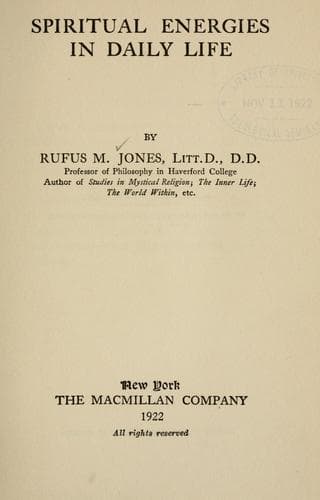
Spiritual Energies in Daily LifeJones, Rufus M. (Rufus Matthew)
Religion
Spiritual Energies in Daily Life
Jones, Rufus M. (Rufus Matthew)
Spiritual life
“That low man seeks a little thing to do,
Sees it and does it:
This high man, with a great thing to pursue,
Dies ere he knows it.
That low man goes on adding one to one,
His hundred’s soon hit:
This high man, aiming at a million,
Misses an unit.”
Browning’s sympathies are plainly with the “high man” who misses the
unit, but it is one more case of unnecessary dichotomy. What we want is
the discovery of a way to unite into one synthesis things present and
things to come. We need to learn how to seize this narrow isthmus of a
present and to enrich it with the momentous significance of past and
future. Henry Bergson has been telling us that all rich moments of life
are rich just because they roll up and accumulate the meaning of the past
and because they are crowded with anticipations of the future. They are
fused with memory and expectation, and one of these two factors is as
important as the other. If either dies away the present becomes a useless
half, like the divided parts of the child which Solomon proposed to
bisect for the two contending mothers.
We are at one of those momentous ridges of time at the present moment.
Some are so busy with the near and immediately practical that they cannot
see the far vision of the world that is to be built. Others are so
impressed with past issues that have become paramount, with the glorious
memories of the blessed Monroe Doctrine, for instance, that they have no
expectant eyes for the creation of an interrelated and unified world.
Another group is so concerned with the social millennium that they
discount the lessons of the past, the message of history, the wisdom of
experience, and fly to the useless task of constructing abstract human
paradises and dreams of a world-kingdom which could exist only in a realm
where men had ceased to be men.
What we want is a synthesis of things present and things to come, a union
of the practical, tested experience of life and the inspired vision of
the prophet who sees unfolding the possibilities of human life raised to
its fuller glory in Christ, the incarnation of the way of love, which
always has worked, is working now, and always will work.
II
TWO TYPES OF MINISTRY
Most people like to be told what they already think. They enjoy hearing
their own opinions and ideas promulgated, and no amens are so hearty as
the ones which greet the reannouncement of views we have already held.
The natural result is that speakers are apt to give their hearers what
they want. They take the line of least resistance and say what will
arouse the enthusiasm of the people before them, and they get their quick
reward. They are popular at once. There is a high tide of emotion as they
proceed to tell what everybody present already thinks, and they soon find
themselves in great demand.
Public-domain text, read in full here on John Shaqi.
Reviews
Reviews
No reviews yet
Be the first to share your thoughts on this work.
Elsewhere in the archive
Join the Discussion
Join the discussion
Sign in to leave a comment or review.
Sign InorCreate an account