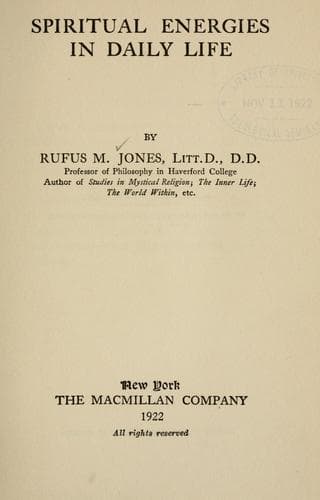
Spiritual Energies in Daily LifeJones, Rufus M. (Rufus Matthew)
Religion
Spiritual Energies in Daily Life
Jones, Rufus M. (Rufus Matthew)
Spiritual life
The main trouble with such an easy ministry is that it isn’t worth doing.
It accomplishes next to nothing. It merely arouses a pleasurable emotion
and leaves lives where they were before. And yet not quite where they
were either, for the constant repetition of things we already believe
dulls the mind and deadens the will and weakens rather than strengthens
the power of life. It is an easy ministry both for speakers and hearers,
but it is ominous for them both.
The prophet has a very different task. He cannot give people what they
want. He is under an unescapable compulsion to give them what his soul
believes to be true. He cannot take lines of least resistance; he must
work straight up against the current. He cannot work for quick effects;
he must slowly educate his people and compel them to see what they have
not seen before. The amens are very slow to come to his words, and he
cannot look for emotional thrills. He must risk all that is dear to
himself, except the truth, as he sets himself to his task, and he is
bound to tread lonely wine-presses before he can see of the travail of
his soul and be satisfied.
Every age has these two types of ministry. They are both ancient and
familiar. There are always persons who are satisfied to give what is
wanted, who are glad to cater to popular taste, who like the quick
returns. But there are, too, always a few souls to be found who volunteer
for the harder task. They forego the amens and patiently teach men to see
farther than they have seen before. Their first question is not, What do
people want me to say? but, What is God’s truth which to-day ought to be
heard through me? and knowing that, they speak. They do not move their
hearers as the other type does; they do not reach so many, and they miss
the popular rewards—but they are compassed about by a great cloud of
witnesses as they fight their battles for the truth, and they have their
joy.
But this is not quite all there is to say. It is not possible to teach
the new effectively without linking it up with the old. The wholly new is
generally not true. New, fresh truth emerges out of ancient experience;
it does not drop like a shooting star from the distant skies. The great
prophets in all ages have lived close to the people. They have not had
their “ear to the ground,” to use a political phrase, but they have
understood the human heart. They have lived in the great currents of
life. They have heard the going in the mulberry trees, and have felt the
breaking forth of the dawning light just because of their double union
with men and God.
Public-domain text, read in full here on John Shaqi.
Reviews
Reviews
No reviews yet
Be the first to share your thoughts on this work.
Elsewhere in the archive
Join the Discussion
Join the discussion
Sign in to leave a comment or review.
Sign InorCreate an account