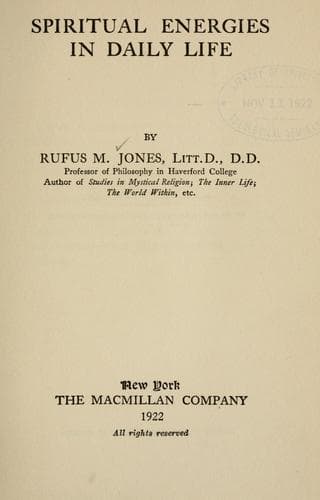
Spiritual Energies in Daily LifeJones, Rufus M. (Rufus Matthew)
Religion
Spiritual Energies in Daily Life
Jones, Rufus M. (Rufus Matthew)
Spiritual life
The Greeks had their story of Tithonus, a deeply significant myth of a
man who could not die, but who grew ever older and more decrepit until
the tragedy became unendurable and he envied those “happy men that have
the power to die.” Methuselah’s biography is brief and compact, but it
is full of pathos: “He lived nine hundred and sixty-nine years and he
died.” There was nothing more to add. Somebody has invented a radium
motor which strikes a little bell every second and is warranted to go
on doing that for thirty thousand years. The Methuselah monotony and
tedium seem much like that thin _seriatim_ row of items. It just goes on
with no novelty and no cumulation, and finally the one relieving novelty
is introduced—“he died.” What a happy fact it was! The wandering Jew
stands out in imaginative fiction as one of the saddest of all men—a
being who endlessly goes on. The angel of death seems a gentle, gracious
messenger when one thinks of the prospect of unending life, going on
in a one-dimensional series, with no new values and no fresh powers of
expansion. To many persons the idea of heaven is simply an expanded
Methuselah biography.
Biologists have completely reversed the theory that death is an enemy.
It has long ago taken its place in the system of teleology, among “the
things that are for us.” Death has, beyond question, and has had, “a
natural utility.” It has played an important _rôle_ in raising life from
the low unicellular type to the rich complex forms of higher organisms,
from “the amœba that never dies of old age” to the new dynasty of beings
that have greater range and scope, but which nevertheless do die. Edwin
Arnold in his striking essay on _Death_ says: “The lowest living thing,
the Protamœba, has obviously never died! It is a formless film of
protoplasm, which multiplies by simple division; and the specimen under
any microscope derives, and must derive, in unbroken existence from the
amœba which moved and fed forty æons ago. The slime of our nearest puddle
lived before the Alps were made!” Methuselah was a mere child in a
perambulator compared to an amœba.
In cases where the continued process of cell-division produced a lowered
and weakened type of amœba a rudimentary form of union of cells took
place, which resulted in raising the entire level of life and eventually
carried the biological order up to wholly new possibilities. So that
the threatened approach of death was met with an increase of life. “It
is more probable that death is a consequence of life,” says the famous
biologist, Edward Cope, “rather than that the living is a product of the
non-living.”[2]
Public-domain text, read in full here on John Shaqi.
Reviews
Reviews
No reviews yet
Be the first to share your thoughts on this work.
Elsewhere in the archive
Join the Discussion
Join the discussion
Sign in to leave a comment or review.
Sign InorCreate an account