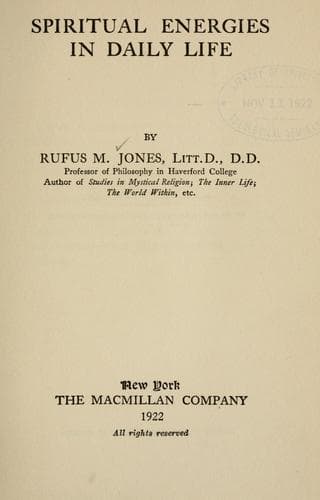
Spiritual Energies in Daily LifeJones, Rufus M. (Rufus Matthew)
Religion
Spiritual Energies in Daily Life
Jones, Rufus M. (Rufus Matthew)
Spiritual life
But in any case the testimony of biology can give us little help. Even if
death has had a function in the process of evolution, as seems likely,
that in no way eases the situation when the staggering blow falls into
our precious circle and removes from it an intimate personal life that
was indispensable to us. It is poor, cold comfort to be told that death
has assisted through the long æons in the slow process of heightening
the entire scale of life, if there is nothing more to say regarding the
future of this dear one whose frail bark has now gone to wreck. We must
somehow rise above the level of brute facts and discover some spiritual
significance which death has revealed, before we can arrive at any source
of comfort. We are all agreed with Shakespeare’s Claudio that “’tis too
horrible” to think of death as a sheer terminus:
“ ... to die and go we know not where;
To lie in cold obstruction, and to rot;
This sensible warm motion to become
A kneaded clod; and the delighted spirit
To bathe in fiery floods, or to reside
In thrilling regions of rock-ribbed ice;
To be imprisoned in the viewless winds,
And blown with restless violence round about
The pendent world.”
Death has undoubtedly brought to consciousness, as has perhaps no other
experience, the deeper meaning and significance of personal life. This
and not its biological function is what concerns us now. It has been
said that “freedom,” so far as it is achieved, “is the main achievement
of man in the past.”[3] I should be inclined rather to hold that man’s
main achievement on the planet so far has been to discover that personal
life reveals within itself an absolute value and possesses unmistakable
capacity to transcend the finite and temporal, an experience which
makes freedom possible. I believe death has ministered more than any
other single fact that confronts us in bringing those truths to clear
consciousness. We cannot, of course, dissociate death and separate it
from pain, suffering, struggle and danger, which are essentially bound up
with it. If the world were to be freed completely from death it would at
once _ipso facto_ be freed from the danger of it and by the same altered
condition struggle would to a large degree be eliminated, and likewise
those other great tests of life—pain and suffering, which culminate in
death. These things are all “perilous incidents” of finiteness, but of
a finiteness which transcends itself and is allied to something beyond
itself. To eliminate these things would be to miss the discovery of this
strange finite-infinite nature of ours which makes life such a venture
and so full of mystery and wonder. If we had been only naturalistic
beings, curious bits of the earth’s crust merely capable of recording the
empirical facts as they occurred, death would have taken an unimportant
place as one more event in a successive series of phenomena. Built as we
Public-domain text, read in full here on John Shaqi.
Reviews
Reviews
No reviews yet
Be the first to share your thoughts on this work.
Elsewhere in the archive
Join the Discussion
Join the discussion
Sign in to leave a comment or review.
Sign InorCreate an account