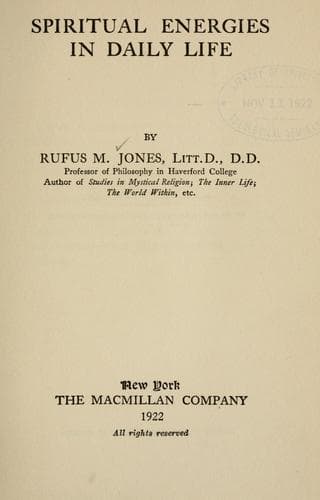
Spiritual Energies in Daily LifeJones, Rufus M. (Rufus Matthew)
Religion
Spiritual Energies in Daily Life
Jones, Rufus M. (Rufus Matthew)
Spiritual life
No such high revolt of spirit was occasioned so long as death was a mere
biological event, terminating one life to give room for another. This
cry of soul means the discovery of the infinite preciousness of personal
life. The mind now turns in on itself and takes a new account of its
stock, and as a result man began to solve the problem of death in an
enlarged way. He was no longer satisfied with a form of survival based
upon his experiences in dreams, trance and hallucination; he came to feel
that he must have a destiny which fitted his spiritual worth as a man. He
finds within himself intimation of powers and possibilities beyond those
required for the struggle of life here. He feels by that same insight
which carries him out beyond the seen to a rational faith in the unseen
that is necessary to complete it, that this little arc of earthly life
with its revelations of spiritual value and its transcendent prophecies
of more must find fulfillment somewhere in a form of life that rounds it
out full circle.
The argument does not build on a passion of desire, as some doubters have
said. We do not assume immortality just because we want it. It rests upon
the moral consistency of the universe, upon the trustworthy character
of the eternal nature of things. The moral values which are revealed in
fully developed personality are certainly as _real_, as much a fact of
the universe, as are the tides or the orbits of planets. If we can count
upon the continuity of these occurrences and upon our predictions of
them, just as surely can we count on the consistency of the universe in
reference to spiritual values. If there is conservation of matter there
is at least as good ground for affirming conservation of moral values.
If biological life can pass over the slender bridge of a microscopic
germ-plasm and can carry with itself over that feeble bridge the traces
of habit and feature, the curve of nose and the emotional tone of some
far-off dead ancestor, and all the heredity gains of the past, may we not
count upon the permanence of that in us which allies us to that infinite
Spirit who is even now the invisible environment of all we see and touch?
It is not a matter of reward or of “wages” that concerns us. It is not
“happy isles” or care-free “Edens” that we seek, not “golden streets”
and endless comfort to make up for the stress and toil of the lean years
here below. We want to find the whole of ourselves, we ask the privilege
of seeing this fragmentary being of ours unfold into the full expression
of its gifts and powers. The new period may be even more strenuous and
hazardous than this one has been—still we want the venture. We ask for
the culminating acts that will complete the drama, so far only fairly
begun. It must be not a mere serial, or straight line, existence; it
must be the opening out and expansion of the possibilities which we feel
within ourselves—new dimensions, please God.
Public-domain text, read in full here on John Shaqi.
Reviews
Reviews
No reviews yet
Be the first to share your thoughts on this work.
Elsewhere in the archive
Join the Discussion
Join the discussion
Sign in to leave a comment or review.
Sign InorCreate an account